Showing posts with label war on terror. Show all posts

2026-09-10

25 years after 9/11, the millions of innocent Muslims killed in the “war on terror” still go unremembered

Muslim victims of US-led wars felt terror no different from that felt by those in the Twin Towers on 9/11. Their deaths were just as violent, yet their suffering is treated as something to be buried, ignored, or rationalized.

By Fareed Khan
A version of this article is also available on Substack.

Twenty‑five years after the 9/11 attacks, Americans will once again gather in New York City at the side of the former World Trade Centre, at the Pentagon, and in the quiet fields of Shanksville, Pennsylvania to honour the 2,977 lives lost on that terrible day. The ceremonies will be solemn and nationally televised. Political leaders will speak of unity, resilience, and the sanctity of innocent life. News networks will replay archival footage of the Twin Towers burning before they collapsed, they will interview survivors, and remind the public of the trauma that reshaped the country.

Yet as these commemorations unfold, another truth—far more uncomfortable, far more morally urgent—remains absent from the public consciousness. For a quarter century, the United States and its allies have waged a global campaign that has killed more than 4.5 million Muslims, made refugees of more than 38 million, and devastated entire societies from Iraq to Libya to Pakistan. According to Brown University’s Costs of War project, US‑led wars since 2001 have killed Muslims on a genocidal scale and created one of the largest refugee crises in modern history. These victims receive no annual remembrance, no televised tributes, no official mourning. Their deaths exist in a political void.

This disparity is not accidental. It reflects a hierarchy of human worth embedded in Western political culture—a hierarchy in which Muslim lives are treated as expendable, forgettable, and undeserving of grief.

A war on terror that became a war on Muslims

In the immediate aftermath of 9/11, fear and anger swept across the United States, creating a political climate in which grief quickly fused with militarism and vengeance. Rather than limiting its response to the perpetrators of the attacks—Al‑Qaeda—the US launched a decades long global military campaign that rapidly expanded far beyond any plausible definition of counterterrorism. Afghanistan was invaded and occupied for two decades. Iraq was invaded and its civilian infrastructure destroyed. Drone warfare was normalized in Pakistan, Somalia, and Yemen. Libya was bombed into a failed state. Syria was destabilized. Across each of these nations, the overwhelming majority of those killed were civilians who had no connection to the crimes of September 11th.

The human toll of these decisions has been staggering. In Iraq alone, more than one million Iraqis were killed as a direct result of the US invasion and occupation in the first few years of the Iraq War, according to multiple studies, with later estimates placing the number of Iraqi dead as high as 2.4 million by 2018. The US drone program—marketed as a precise, surgical tool—killed 40,201 people across Afghanistan, Pakistan, Somalia, and Yemen in extrajudicial murders, including at least 25,835 civilians whose deaths were never acknowledged by the American administrations responsible. When all theatres of conflict are considered together, US‑led wars since 2001 have killed millions of people, with death toll numbers that dwarf the 9/11 death toll by more than 1,500 times, yet they occupy no space in Western public memory.

Despite the scale of this devastation, the victims of the “war on terror” remain unnamed, unacknowledged, and ungrieved by those that killed them. Their deaths are treated not as human tragedies but as abstractions—statistics buried in academic studies, collateral damage rationalized as unfortunate but necessary, and lives erased from the moral landscape of Western political consciousness. This erasure is not incidental. It reflects a deeper ideological pattern in which Muslim suffering is rendered invisible, and the humanity of Muslims is consistently devalued in Western discourse.

How the war on terror reshaped global norms

The expansion of the war on terror reshaped global norms around acceptable violence, legality, and accountability. It normalized forms of warfare that operate outside the laws of war and the international rule of law—drone strikes conducted without due process, assassinations based on secret intelligence, and military operations justified by elastic definitions of “imminent threat.” It entrenched a worldview in which entire Muslim‑majority societies were framed as breeding grounds for extremism, making mass violence against their citizens not only permissible but also justifiable.

This worldview created a geopolitical environment where Western military action became both continuous and unrestrained. It allowed governments to wage war indefinitely, without public debate, without legislative scrutiny, and without acknowledging the toll of innocent human lives. It also ensured that Muslim casualties would remain invisible, because acknowledging them would require confronting the moral consequences of policies pursued for decades, and facing calls for those who instigated the attacks to be held legally accountable.

The normalization of this violence also produced a dangerous precedent. It signaled to other nations that the erosion of international law was acceptable if framed through the language of counterterrorism. Countries with their own political agendas began adopting similar tactics—mass surveillance, extrajudicial killings, indefinite detention, torture—claiming they were merely following the example set by the world’s most powerful democracies. In effect, the war on terror became a global template for repression, and weakened the very institutions designed to protect civilians, thereby undermining the credibility of human rights frameworks, and emboldened authoritarian governments to pursue their own campaigns of violence under the guise of “national security.” The result was a world in which the boundaries of lawful warfare blurred, accountability mechanisms collapsed, and the suffering of Muslim populations became both normalized and politically inconsequential.

The inequality of grief

Every September 11th, American leaders have spoken of the “innocence” of the 9/11 victims and the “evil” of terrorism. They speak of the “duty to remember.” But they do not speak of the Afghan wedding parties bombed by US aircraft killing hundreds at a time. They do not speak of the Iraqi families obliterated by US missiles resulting in children losing their limbs along with their parents and siblings. They do not speak of the Pakistani grandmother killed while picking vegetables in her garden with her grandchildren being blown to bits. They do not speak of the Yemeni children killed in drone strikes, their body parts scattered across an obliterated playground.

These victims experienced terror no different from the terror felt by those in the Twin Towers on 9/11. Their deaths were just as violent, just as sudden, just as undeserved. Yet their suffering is treated as politically inconvenient—something to be buried, ignored, or rationalized.  This is not merely neglect. It is a form of dehumanization.

The inequality of grief is one of the most revealing moral failures of the past quarter century. It exposes the racial hierarchy embedded in Western political life—a hierarchy in which the deaths of nearly 3,000 Americans are commemorated annually with solemn ceremony, while the deaths of more than 4.5 million Muslims are treated as mere background noise. It reveals a profound hypocrisy in Western claims to value human rights and universal dignity. And it demonstrates how easily the language of counterterrorism can be weaponized to justify mass violence against entire populations deemed foreign, threatening, or expendable.

The devaluation of Muslim life

Why is there no annual commemoration for the millions of Muslims killed in the war on terror? Why is there no official recognition for the 38 million refugees created by the US led war on terror? Why aren’t the names of any of these victims carved into memorials, and why are none of their families interviewed by Western news organizations? Why are their stories not taught in schools?

The answer is uncomfortable but unavoidable. Their lives are not valued equally, neither by the governments who caused their death nor by the Western media organizations that dutifully tell the stories of 9/11 victims while ignoring the story of the barbarism of those who joined the US in its global war.

Ignoring the millions of innocent victims of America’s war on terror implies that their lives have lesser value in Western eyes than those of American victims of terrorism. The fact that these victims are overwhelmingly Muslim underscores how deeply anti‑Muslim bigotry has become embedded not only in Western political culture but also in the news media systems that shape public perception. This devaluation did not emerge organically. It was constructed—deliberately, repeatedly, and strategically—through a political narrative that required a compliant media infrastructure to make war palatable to the public.


For a war of such scale to be justified, sustained, and normalized, it had to be sold. And it could only be sold if the public was conditioned to see Muslim lives as inherently less worthy of empathy, protection, or moral consideration. That conditioning required a steady stream of Islamophobic narratives—stories that framed Muslims as threats, as extremists, as enemies of civilization. Political leaders supplied the rhetoric while media institutions amplified it.


This partnership between political power and media influence ensured that the dehumanization of Muslims was not merely a by‑product of war but a prerequisite for it. By saturating public discourse with narratives and images of violence committed by a tiny minority of extremists, while erasing the far greater violence inflicted on Muslim civilians by Western militaries, the media helped construct a worldview in which Muslim suffering was invisible, Muslim death was inevitable, and Muslim humanity was negotiable.


This inequality of grief reveals something profound. It reveals racism, because the victims are overwhelmingly non‑white. It reveals inhumanity, because their suffering is treated as collateral damage rather than human tragedy. And it reveals hypocrisy, because the West claims to champion human rights while ignoring the largest civilian death toll of the 21st century.  If the West truly believed in universal human dignity, it would commemorate all victims of terror—whether killed by non‑state actors or by Western militaries. 

Real equality would mean acknowledging that the terror experienced by a child in Fallujah is no different from the terror experienced by a worker in the North Tower. Real equality would mean recognizing that the grief of a Somali mother is no different from the grief of a New York widow. Real equality would mean commemorating the millions killed by US bombs, missiles, drones, and invasions with the same solemnity afforded to the victims of 9/11.

If the West is sincere in its commitment to human rights, then it must expand its circle of mourning. It must honour not only the victims of one act of terrorism, but the victims of the state terrorism carried out by the US and its allies in response to the 9/11 attacks. It must recognize that all innocent lives have equal worth.

Whether such a remembrance happens on September 11 or another day is immaterial. What matters is the moral principle, that all victims of terror deserve to be remembered.

© 2026 The View From Here. © 2026 Fareed Khan. All Rights Reserved.

2025-11-11

On Remembrance Day let’s remember that war is the supreme evil, wherever and whenever it occurs

Nowhere is the evil that is identified in the final judgment from Nuremberg more brazen than in Israel’s genocidal war on Gaza—a 21st Century reincarnation of what the Nazis did.

By Fareed Khan
A version of this article can be found on Substack.

“War is essentially an evil thing. Its consequences are not confined to the belligerent states alone, but affect the whole world... A war of aggression is the supreme international crime differing only from other war crimes in that it contains within itself the accumulated evil of the whole.”


These words, etched into the judgment of the Nuremberg Trials following World War II, were not mere rhetoric. They were a solemn indictment of leaders who unleashed industrialized slaughter on humanity, convicting Nazi architects of crimes that devoured 70 to 85 million lives—over 50 million civilians among them. As the gavel fell in 1946, the world vowed (once again) to never to forget war’s futility, its horror, its senseless grind of flesh and bone for the egos and greed of dictators, kings, presidents and prime ministers.

Yet here we stand, on another Remembrance Day in Canada, gazing at the sea of red poppies worn on lapels and laid at cenotaphs that honour the fallen and the scarred—soldiers who marched into the maw of machine guns, who clawed through mud-choked trenches, who watched friends dissolve in clouds of chemical weapon. We commemorate their sacrifice, their valour, their unbreakable spirit, but at the same time we tarnish their sacrifice by being complicit, as a nation, in the very sort of evil they fought in World War II.

Ceremonies swell with anthems and wreaths, stirring national pride and sombre reflection. But in this ritual of reverence, the true venom of war—the supreme evil named at Nuremberg—is whispered only in passing, if at all. We gloss over the architects—the foolhardy politicians whose vanities birthed these cataclysms. We sentimentalize the survivors while burying the deeper truth—that war is not noble tragedy but orchestrated abomination, a crime that devours innocents for fleeting gains. And today, as Western leaders, including those in Canada, funnel arms into fresh infernos, we risk repeating history’s gravest sin—complicity in aggression’s accumulated evil.

Since 9/11 and the Afghanistan War, where 165 Canadians died, Remembrance Day has morphed into a spectacle laced with nationalism and political theatre. In Canada, politicians drape themselves in solemnity, invoking the ghosts of Vimy Ridge, Juno Beach and the Battle of Kandahar to stoke unity. But this veneer obscures the
ugly genesis of our traditions.

The First World War was no inexorable clash of ideologies fated to happen. It was the bastard child of European egos—emperors, kings and politicians, entangled in a web of alliances forged by imperial hunger that knocked over the first domino leading to
international catastrophe. A century of fragile peace, from Waterloo to Sarajevo, shattered by the assassination of an archduke and an ensuing crisis of ultimatums and mobilizations too rigid to halt. Germany’s blank cheque to Austria-Hungary, Russia’s hasty full mobilization, Britain’s deployment to support Belgium—all foolhardy gambles that dragged empires into four years of slaughter.

By 1918 between 17 to 22 million lay dead, with over 10 million civilians starved, diseased, or shredded by bombs and artillery, with 25 million more wounded, their bodies and minds irreparably broken. Trench warfare birthed death on an industrialized level with the use of poison gas, tanks, and barbed wire turning open fields into abattoirs of human remains. For what? The war’s futility was etched in a poem by Wilfred Owen, “
Anthem For Doomed Youth” which evoked horror: “What passing-bells for these who die as cattle?”

The Treaty of Versailles, meant to end the nightmare and prevent future wars, instead sowed the seeds of its sequel. Punitive reparations crippled Germany, fuelling resentment that Adolf Hitler weaponized to launch World War II, wanting to “make Germany great again”. This second apocalypse claimed between 70 and 85 million souls, with over 50 million civilians gassed, bombed, or starved in genocidal fury. The Nazis embodied pure aggression, their blitzkriegs and death camps was the distilled evil that Nuremberg condemned.

The Americans, the British and Canadians landed at Normandy beaches on D-Day with more than 4,400 killed in the landings. As Allied troops broke through the lines of German defences the cost in human lives was more than 600,000, not counting the civilians who were caught between the two forces. Counting losses in both world wars over 111,000 Canadians, more than 533,000 Americans, and over 983,000 British military personnel died, their blood spilled in conflicts politicians could have averted through diplomacy if they truly believed in peace.

After the German and Japanese surrendered in World War II, the pattern persisted, a grim refrain. Just five years after Hiroshima and Nagasaki saw over 200,000 civilians incinerated by the US, the Korean War erupted—a Cold War conflict scripted by superpowers. North Korea, backed by China and the Soviets, invaded the South, and the UN coalition, led by the US (including 26,000 Canadians) countered. What began as ideological saber-rattling teetered on nuclear brinkmanship, ultimately killing 3 to 3.5 million—two million civilians pulverized by bombs, napalm and artillery by 1953. Villages were razed as families fled, not for honour but for the Cold War’s chessboard. Today as those who gave their lives on battlefields are commemorated, there are no parades or ceremonies for the millions of civilian victims of the war machine, their memories fading into footnotes.

“There is no honour in war,” is a sentiment embraced by many, including those who have returned home bloodied and disfigured from battlefields. War is a senseless slaughter for economic plunder or political advantage where the vast majority of victims are not combatants. The 20th century’s ledger drips rivers of blood as civilians, once peripheral to the battles of history. are now those who are the primary victims, courtesy of so-called “smart” bombs and cluster munitions that claim to spare the innocent but never do.

Post-9/11, Western wars—led by the US—unleashed hell in Afghanistan, Iraq, Libya, Syria, Yemen, Somalia and Pakistan. The Costs of War Project tallies
4.5 to 4.6 million dead (primarily Muslims and Arabs), with more than 38 million displaced. One analysis pushes the total number of dead to 6 million, the unrecorded results of war’s rubble and ruin. The illegal invasion of Iraq, which Canada dodged, but the fallout of which we reaped, birthed instability in the Middle-East and the carnage in Syria. Millions of Muslims perished in 25 years of such “interventions,” but there are no cenotaphs or monuments for them. These wars, sold as liberation for oppressed peoples, or efforts to root out terrorism, were aggression’s kin—resource grabs or political aggression masked as righteousness, destabilizing a region with more than 400 million people to the point that it has become a perpetual pyre.

As Canada’s
World War II veterans dwindle—now numbering under 30,000, averaging 94 years of age—their visceral testimonies fade. The acrid smell of cordite, the screams of the eviscerated, and the stench of rotting bodies—these horrors will recede and the veterans’ stories will be romanticized by some to advance political agendas. When the last veteran passes the insanity of global war risks being slowly erased, leaving only myths of glory. Those who organize Remembrance Day related events must change how the day is commemorated and reclaim the unvarnished horror of war, not just remembering the dead and maimed, but the evil that dispatched them into a maw of horror fed by lies about “protecting democracy” while peddling fear at home.

Nowhere is the evil that is identified in the final judgment from Nuremberg more brazen than in Israel’s genocidal war on Gaza—a 21st Century reincarnation of what the Nazis did. Since October 7, 2023,
over 75,000 Palestinians have been killed according to official numbers—with one Harvard published study by Israeli academic Yaakov Garb putting the death toll at more than 377,000, and another by two Australian professors asserting that more than 680,000 Palestinians have been killed by Israel.

More than 80% of Gaza’s structures have been levelled under Israeli bombardment, children have been bombed in “safe zones”, hospitals and health facilities have been decimated, aid convoys attacked, and food weaponized to orchestrate famine. This is the evil that the Nuremberg judgment spoke of that should be prevented. But here we are in 2025 watching Israel commit crimes no different than what the Nazis inflicted on millions and yet those countries (Canada included) who support the so-called “international rule of law” do nothing to stop it, even though they have the power to do so.

The UN’s September 2025
Commission of Inquiry declared Israel’s actions in Gaza constitute genocide, citing four acts under the 1948 Genocide Convention—mass killing, serious harm, life-destroying conditions, birth prevention—inflicted with intent, incited by Israeli prime minister Benjamin Netanyahu and his cabinet, carried out by his military leaders, and supported by almost half of Israeli society according to a Ha’aretz poll. Amnesty International, Human Rights Watch, B’Tselem echo the UN’s conclusions—deliberate starvation, sabotaging water facilities, starvation as a weapon, reproductive devastation. Israeli data itself reveals that 83% of the dead are civilians, a number unparalleled outside Rwanda or Srebrenica. When leaders dehumanize—”eliminate anything that walks or breathes”—and raze health facilities, cut power to incubators for babies, destroy, the hate and aggression has reached an apex and is an example of the accumulated evil referenced in the Nuremberg judgment.

Yet despite the mountains of evidence—
videos, eyewitness testimonies, media reports, social media posts by the Israeli soldiers themselves—Western nations, Nuremberg’s heirs, fuel this inferno. The US pumps $3.8 billion in military aid annually into Israel, plus more than $20 billion since October 2023 in munitions that have pulverized Gaza. The UK, despite suspending 30 export licenses in September 2024, shipped F-35 parts for jets dropping 2,000 pound bombs on schools and tent camps. Canada, feigning a higher morality, exported $18.9 million in weapons components in 2024, adding $37.2 million more by mid-2025, including 421,000 bullets and mortar cartridges via US loopholes. Our political leaders—Justin Trudeau and Mark Carney—have blood soaked hands in a conflict which they hypocritically condemn, while arming the aggressor. This is complicity, plain and simple. They aid Israel’s crimes according to UN experts, while violating the Arms Trade Treaty. Over 60 states, mostly Western, bear this stain, acting as diplomatic shields and economic lifelines, or providing ideological alibis that perpetuate Israel’s genocidal carnage.

On this Remembrance Day, as bagpipes wail and poppies are laid at cenotaphs, let us pierce the pomp and circumstance with a dose of present day reality. Let’s honour the fallen not with platitudes, but by naming war’s evil—the aggression that orphans generations, poisons futures, and mocks the vow made after Nuremberg’s convictions. Those who served after World War II—Canadian sons and daughters—were sent overseas believing the lie that they were fighting for freedom, shielding innocents. Many died needlessly as pawns played by political egos, and while their names grace tombs and monuments their memories are being disgraced by the government and politicians that sent them off to kill brown people.

To truly commemorate November 11th, we must dismantle the ideologies that sow the seeds of war—militarism, imperialism, colonialism, Islamophobia, white supremacy—these are the cancers that are war’s siren call. We must hold politicians accountable for their own complicity, demanding arms embargoes, and an end to support for criminal regimes. We must fight the stealth erosion of our rights via fear mongering bills, the creation of a surveillance state, and hate laws cloaked in the blanket of security and protection. If we fail, letting Gaza’s screams join the echoes of Vimy Ridge, Flanders, and the Dieppe raid, we spit on the fallen. Their blood bought us liberties we squander—speech unbound, bodies sovereign, humanity indivisible. War’s futility is not fate, it’s a choice. We must choose differently by ending the supreme crime and remembering it on the day we commemorate the fallen. If we don’t, the merciless judge of history will convict us all, and we will never see real justice in a world that is becoming more lawless at the hands of national leaders who match the evil of Nazi Germany.

© 2025 The View From Here. © 2025 Fareed Khan. All Rights Reserved.

2025-09-11

Why are the lives of 9/11 victims valued above those of the millions of victims of the “War on Terror”

There are no memorials to honour the millions killed in Iraq, Afghanistan and the "War on Terror," and no moving annual commemoration ceremonies like those for the victims of the 9/11 attacks.

A version of this article can be found on Substack. 

Every September 11th, the United States and its allies pause to commemorate the 2,977 lives lost in the horrific terrorist attacks of 2001.  Solemn ceremonies unfold at  “ground zero “ in New York City, the Pentagon in Washington DC, and a field in Pennsylvania, accompanied by poignant statements from politicians vowing to never forget.  These rituals honour the victims of a single day ‘s horror, etched into the collective memory of the United States and the West.

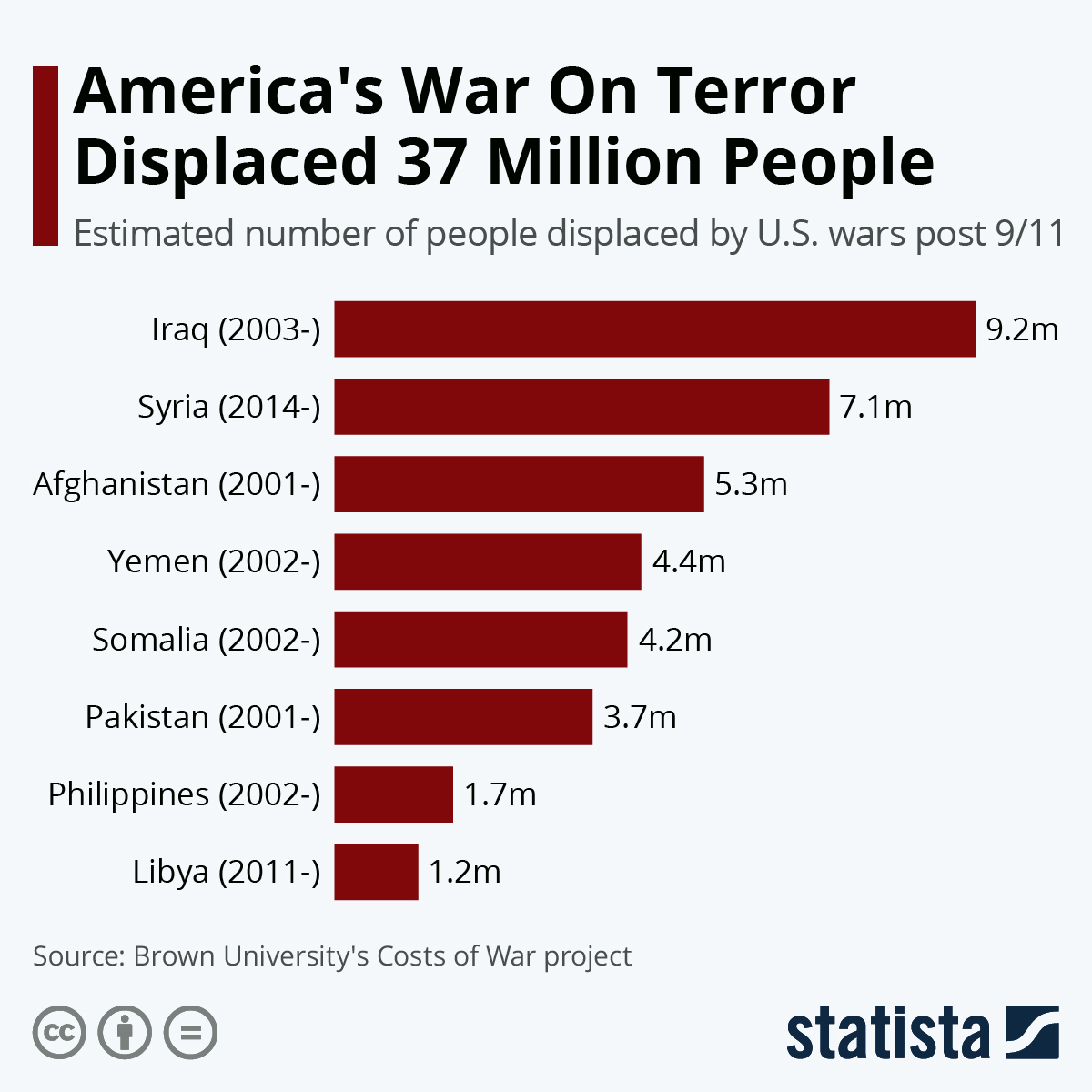
https://cdn.statcdn.com/Infographic/images/normal/22902.jpeg

Yet, as we reflect on the 24th anniversary of 9/11, a glaring question remains unanswered. Why are the lives of those killed on September 11, 2001 deemed more worthy of remembrance than the hundreds of thousands—possibly millions—of innocent civilians, predominantly Muslim, killed in the US-led wars in Afghanistan, Iraq, and the broader  “War on Terror“?  This selective mourning reveals a troubling double standard and Western societal prejudice that disregards the humanity of these forgotten victims and perpetuates a cycle of violence that has made the world less safe due to US actions and policies.

The 9/11 attacks were a profound tragedy, a moment of collective trauma that reshaped global politics.  The horror of that day—planes crashing into towers, buildings collapsing, and lives extinguished—remains vivid for those who witnessed it, whether in person or through relentless news coverage.  For Muslim communities, the attacks also sparked fear and foreboding, as they braced for the inevitable backlash.

Within months, the US launched its  “War on Terror, “ a sprawling global military campaign that included the invasions of Afghanistan and Iraq, a years long campaign of drone strikes in Pakistan, Yemen, Somalia and other nations, and other operations targeting suspected terrorists wherever they were situated.  These actions, justified as a response to 9/11, have left a trail of devastation, with civilian deaths exponentially surpassing the toll of the original 9/11 attacks. Yet, the victims of these wars—men, women, and children who experienced their own terror from bombs, bullets, and missiles fired by the militaries of the US and its allies—are rarely acknowledged, let alone commemorated, in Western society.

The horrendous civilian death toll


The scale of civilian casualties in the War on Terror is staggering.  A 2006 study by Johns Hopkins University, published in The Lancet, estimated that 655,000 Iraqis had died by the middle of the year as a direct result of the US invasion, with later estimates suggesting a death toll of up to 940,000.  In Afghanistan, the Costs of War project at Brown University estimates over 400,000 civilian deaths, including those killed directly by conflict and indirectly through disease, malnutrition, displacement and destruction of societal infrastructure.  Drone strikes, a hallmark of US counter-terrorism since 9/11, have killed at least 25,835 civilians across Afghanistan, Pakistan, Yemen, and Somalia, according to data from the Bureau of Investigative Journalism. Additional analysis, put the cumulative death toll in all of America ‘s post 9/11 wars at between 4.5 million and 4.7 million, a number more than 1,500 times greater than the casualties of September 11, 2001.

These numbers represent not just lives lost but families wiped out, communities destroyed, societies shredded, and futures erased.  Each death carried the same weight of terror as those felt by the victims of 9/11, yet these people, who also had loved ones, remain largely invisible in Western memory.

The human cost is vividly illustrated by individual stories of loss.  In 2003, Ali Ismail Abbas, a 12-year-old Iraqi boy, lost both arms when a US missile struck his family ‘s home near Baghdad due to faulty intelligence, killing his father and pregnant mother, his brother and 13 other members of his family. The attack also left third degree burns covering at least 35% of his body.

In 2002, a US B-52 bomber dropped a bomb that obliterated a wedding party. What should have been a joyous occasion resulted in the death of up to 250 civilians.  Then US forces launched a two-hour assault on the location with additional bombs and an AC-130 gunship after mistaking the wedding guests‘ celebratory gunshots into the air as hostile fire, and raining hell down on the wedding venue.

In October 2012, Momina Bibi, a 67-year-old Pakistani grandmother, was killed by a US drone strike while picking vegetables with her two grandchildren, who were also injured.  There were no military targets nearby, and she and the children were clearly visible in the field and could not have been mistaken for insurgents.  Her son, Rafiq ur Rehman, a primary school teacher appeared at a hearing on Capitol Hill with his children, Zubair (13), and Nabila (9), and through a translator said, “Nobody has ever told me why my mother was targeted that day."

In August 2021, a US drone strike in a residential area of Kabul killed ten members of an Afghan family, including seven children, again due to faulty intelligence.  The youngest victims of the attack were two 2-year-old girls who were in a car that was targeted.  Neighbours who rushed to help put out the fire resulting from the attack described body parts strewn around the site of the airstrike.  At a funeral held later family members shouted  "Death to America."

These are only a handful of incidents among tens of thousands across Afghanistan, Iraq, Pakistan, Somalia, and Yemen, revealing a pattern of reckless disregard for civilian lives by the US. The euphemism “collateral damage” masks these preventable tragedies, leaving survivors with lasting physical and psychological scars, their grief intensified by the failure of the US to acknowledge or be held accountable for its actions. This silence betrays a deep-seated bias, devaluing Muslim and Arab lives and reinforcing systemic prejudice in Western consciousness.

Compensation for some victims and not others

In the year following the 9/11 attacks the US government established the 9/11 Victim Compensation Fund, disbursing $7.375 billion to victims and their families.  In contrast, compensation for civilian victims of US military aggression has been rare and minimal, often limited to token payments or none at all.  For example, families of drone strike victims in Pakistan and Yemen have received little to no redress, and when it has been offered, payments have been insultingly low compared to payouts for families of 9/11 victims. 

Additionally, there are no memorials to honour the millions killed in Iraq or Afghanistan.  And there are no Western leader delivering moving speeches at annual commemoration ceremonies to mourn the loss.  This silence reinforces a hierarchy of grief, where American lives are deemed more valuable than those of Muslim civilians in distant lands.

The consequences of this double standard extend far beyond moral failure, and impacts security and safety.  America’s military response to 9/11 has made the world less safe, including for Americans. The wars in Afghanistan and Iraq destabilized the Middle East, fueling insurgencies and creating fertile ground for groups like ISIS. 

Civilian deaths, seen merely as “collateral damage,” dehumanizes Arab and Muslim populations and leads to the radicalization of families and communities who lost loved ones to attacks by the US or its allies, in turn creating cycles of revenge.  The 2013 testimony before Congress by the son and children of the Pakistani grandmother killed by a US drone highlights how such strikes breed resentment, pushing survivors toward extremism.

Travelling Americans also face heightened risks abroad, as the actions of their government have eroded goodwill in many nations.  The Costs of War project estimates that the War on Terror has cost over $8 trillion, surpassing the cost of World War Two when adjusted for inflation, and yet it has failed to eliminate terrorism, and instead spread political instability and created breeding grounds for terrorists in the Middle East and across North Africa.

The erosion of civil liberties


This selective mourning has also perpetuated a cycle of anti-Arab racism and Islamophobia that continues to haunt Muslim communities.  In addition, post-9/11 policies, such as the Patriot Act in the US and similar laws in Canada and Europe, eroded civil liberties, and disproportionately targeted Muslims.  These measures, often justified under the banner of “national security,” have planted the seeds of distrust and alienation, damaging the fabric of Western societies, and further marginalized Muslim populations.  The lack of acknowledgement for the victims of US wars has also reinforced the narrative that Arab and Muslim lives are expendable, emboldening right-wing rhetoric that vilified entire communities for the actions of a few.  This dehumanization not only undermines global solidarity but also hinders efforts to address the root causes of terrorism, such as oppression and foreign intervention (primarily by the US) into the politics of other nations.

To break this cycle, we must expand the scope of 9/11 remembrance to include all victims of terrorism, whether perpetrated by non-state actors or states.  The terror felt by an Afghan, Pakistani or Yemeni family obliterated by a drone strike is no less real than that experienced by those who were in the Twin Towers or on the passenger jets used as missiles.  A global day of remembrance for all victims of terrorism could serve as a powerful gesture of united humanity, acknowledging the shared suffering of those affected by violence. Such an initiative would require Western leaders to confront uncomfortable truths about the roles of their nations in perpetuating terror, including the war crimes committed in Iraq and Afghanistan.  It would also demand accountability, such as prosecuting those responsible for illegal wars and ensuring meaningful compensation for victims of US actions.

Moreover, recognizing these forgotten victims could help dismantle the narrative of American exceptionalism that underpins the War on Terror.  By valuing all lives equally, we can challenge the notion that Western suffering is uniquely worthy of mourning.  This shift could foster dialogue and reconciliation, reducing the resentment that fuels extremism.  For example, acknowledging the pain of families like that of Momina Bibi and providing restitution could demonstrate a commitment to justice, potentially mitigating the radicalization of their communities.  It would also signal to the world’s two billion Muslims that their humanity matters, countering the Islamophobia that has poisoned global relations since 9/11.

Until we confront this double standard, the legacy of 9/11 will remain incomplete. Commemorating only American victims while ignoring the hundreds of thousands killed by the US and it allies perpetuates a narrative that dehumanizes Arab and   Muslim lives and excuses state terrorism. It is time to expand our moral imagination and mourn all who have suffered, and to work toward a world where no innocent life is deemed expendable.  Only then can we claim to honour the true cost of 9/11 and build a future where peace, not vengeance, prevails.

© 2025 The View From Here. © 2025 Fareed Khan. All Rights Reserved.


2021-11-11

Senselessness, horror and futility of war not really discussed on Remembrance Day

War should be remembered for the utter horror that it is, the fact that politicians have sent other people's children off to die, and that Remembrance Day also commemorates a very ugly history.

By Fareed Khan 
 
Today, November 11th, the nation marked another Remembrance Day – a day to remember the soldiers sent off to fight wars far from home who never returned.  However, since the 9/11 terrorist attacks politicians in Canada and other Western nations have made a spectacle of the occasion.  While on its surface the day is used to acknowledge Canadian soldiers who made the ultimate sacrifice, it is now also used to instill nationalism and sentimentality in the populace, and for political gain by glossing over the ugly history behind this tradition.
War should be remembered for the utter horror that it is, and the fact that politicians have sent other people's children off to die. The red poppy and Canada’s national cenotaph represent sacrifice but they do not convey the true horror of what war is.  As the veterans of the most horrific wars of human history dwindle the carnage and brutality they witnessed fades into the past and out of the public’s consciousness.  When the last veteran of World War 2 is no more the true insanity of what war is will likely also fade and be forgotten.

The First World War need not have happened. It was the result of foolhardy European politicians, men with egos from both sides, who for reasons of imperial ambition broke a decades-long peace and sent men off to be slaughtered in the killing fields of Europe, and to the colonial outposts of European empires in Africa, the Middle-East and the Far East.  “The Great War” inflicted death and carnage on an unimaginable scale with industrial efficiency.  And estimated 17 to 22 million people died, of which more than 10 million were innocent civilians, and over 25 million were among the injured.

The outcome of that war and the terms of the Treaty of Versailles, where the winners sought outrageous amounts of reparations from the losing side, is what laid the foundations for World War Two.  The dead in that conflict numbered more than 70 million by conservative estimates. The civilian dead in that war numbered more than 50 million.  When the world went to war for a second time in the 20th Century there was a real enemy bent on evil and world domination.  However, it was an evil whose seeds were planted by the actions and politics of the First World War's allied powers.

Only five short years after the end of World War 2, a collection of nations were at war again in the Korean peninsula after North Korea and China supported by the Soviet Union invaded South Korea.  The Korean War was the first major conflict of the Cold War and had the potential to morph into a nuclear conflict.  It too was a war of empire between the United States and the Soviet Union, the two strongest military powers in the world at the time. Over 3.5 million people died in the Korean War from both sides, with civilians making up 2,000,000 of that total.

There is no honour in war. It is senseless slaughter primarily for economic or political gain. That is what the majority of wars of the last century have been, with civilians comprising an increasing number of the dead because governments have found more lethal ways of indiscriminately killing, despite whatever they might say about trying to avoid civilian casualties.

Since the 9/11 terrorist attacks approximately one million innocent civilians (the population of Ottawa) have been killed by Western nations (primarily the US) in Iraq, Afghanistan, Pakistan, Yemen and Somalia, with one estimate putting the number of deaths as high as 6 million.  But there are never any ceremonies to remember them, and the illegal war in Iraq, which Canada wisely refused to join, created the horror of ISIS that is now resulting in more innocent lives being lost.

So as Canada remembers the fallen today we should remember the ugly history behind why this day is commemorated.

We should remember that those who served and died were for the most part honourable, and many died needlessly for the sake of ego, greed, ambition and politics.  Those who sacrificed believed they were fighting to protect democracy and freedom at home and innocents abroad because that is what the politicians who sent them off to fight told them.

Additionally, if we are going to honour the memory of the fallen we should do so not just by remembering them with pomp and circumstance on one day of the year.  The best way that we can remember and honour them is to fight at home against hateful ideologies like fascism and white supremacy, to ensure that the rights and liberties which they were willing to die for are not taken away from us, and to ensure that the freedoms we value are not slowly stripped away by governments and politicians through instilled fear and stealth.

If we fail to do that, if we do not hold our politicians to account and stand up in defence of our rights, we are spitting on the memory of the fallen, and dishonouring the sacrifices they made to give us the freedoms and liberties many of us take for granted.  We can do much better and we should.
 
 © 2021 The View From Here.  © 2021 Fareed Khan.  All Rights Reserved.

2014-05-16

9-11 Museum Opening Ceremonies Silent on the Hundreds of Thousands Killed by America's "War On Terror"

By Fareed Khan
 

It was a solemn day in New York City yesterday (May 15, 2014).  This day marked the official opening of the 9/11 museum which commemorates the terrorist attacks of September 11, 2001 on the World Trade Center and the Pentagon.  The museum is the principal institution concerned with exploring the implications of the events of the September 11th terrorist attacks and documenting the impact of those events.  But for the majority of American it is seen as the national memorial to the 2,977 people who were victims of 9/11.  The museum opening received wide media coverage , as is appropriate for the opening of a memorial for such a tragic event.

But while it was solemn day for those in New York City the opening of the museum should also be marked as a tragic day for the millions of people who were half a world away, had no direct involvement in the attacks of September 11th, and yet are victims of 9/11 just as much as the people who died on that sunny Tuesday morning.  I refer to the people of Iraq and Afghanistan who became victims of violence perpetrated by the United States and its allies as it lashed out in response to the events of September 11th.

The tragedy of yesterday's museum opening is manifested in the fact that while the deaths of the 9/11 victims are being remembered in the U.S. by the opening of a memorial that cost over $700 million to build, totally forgotten is the reality of the  many hundreds of thousands of innocent Iraqi and Afghani men, women and children who died as a direct result of America's "war on terror", a war which was justified in the name of those who were killed on 9/11.

These are innocent victims who have no national memorials and are only remembered in the hearts and minds of their family members.  Their deaths and life changing injuries are not and will not be an occasion for mass media events, museums or memorials.  There will be no heartfelt speeches about them by political leaders.  And the public will not see their photograph on a commemorative wall or hear the voices of their family members describing their tragic last moments of life.  And there will be few in the United States or other western countries that will remember their faces let alone mourn for them.

It is conservatively estimated that the American-led efforts to combat terrorism has directly resulted in the deaths of over 500,000 people in Iraq alone, created approximately 4.5 million refugees in the countires where the U.S. has launched military actions, and has cost the American government more than $6 trillion.  And this cumulative body count does not include those who have died due to the suffering caused by the destruction of civilian infrastructure (i.e. hospitals, water/sewage treatment facilities, power generation plants, etc.).

Related:
*  Innocent Victims in the Global War on  Terror
*  Millions of refugees are hidden victims of the West's war on terror, warns UN
*  Casualties of the Iraq War
*  Lancet Survey of Iraq War Casualties
*  Civilian Casualties in the War in Afghanistan

The solemnity of the New York City event was punctuated by the fact that it was attended by President Barack Obama and his wife Michelle.  Also in attendance was a who's who of political heavy weights, including former president Bill Clinton and former secretary of state Hillary Rodham Clinton, New York Governor Andrew Cuomo, New Jersey Governor Chris Christie, current New York City Mayor Bill de Blasio, former mayors Michael Bloomberg and Rudy Giuliani, and former New York governor George Pataki.  In addition to the political celebrities in attendance were many family members of 9/11 victims as well as some of those who survived the collapse of the twin towers.

In his remarks during the opening ceremonies President Obama said that the "sacred place of healing and hope" will ensure that "generations yet unborn will never forget" the worst terrorist attack on U.S. soil. 

It is unlikely that what happened on 9/11 will ever forgotten given how the events of that day were seared into the memories of millions of people in the United States and hundreds of millions around the world by the media, by the volumes of academic research that has been devoted to this single act of terrorism over the 12 years since the event, and because of the geopolitical actions undertaken by the U.S. government in the aftermath of the attacks.

Yes, yesterday was a solemn day in New York City, and the September 11th attacks and their victims should be remembered.  But we in the West also need to remember the hundreds of thousands if not millions of people who have been killed and maimed (directly and indirectly) because of the so-called ‟war on terror”.

We need to remember the face of Ali Ismail Abbas, a 12 year old Iraqi boy, who lost his limbs as well as his parents and extended family when his family home was ‟accidentally” bombed by U.S. forces in 2004.


We need to remember the scores of people killed in a wedding party (including women and children) in southern Afghanistan in 2002 when the celebration in their village was bombed because military analysts incorrectly thought it was a gathering of Taliban insurgents.

And we need to acknowledge the physical and psychological trauma suffered by hundreds of thousands of families in Iraq, Afghanistan and other countries who mourn their dead outside of the media spotlight, without multi-million dollar memorials commemorating their dead, and out of the minds of vast majority of people in the west who don't give a second thought to the innocent victims that have died and suffered, victims who are not memorialized in a museum in New York City. Only if we do that can we legitimately claim the right to our belief that we are a compassionate, caring and civilized society.


NOTE: All links in this article were current and working at the time of posting.  If any links no longer work please post a note and the problem will be corrected where possible. 

© Fareed Khan.  © All rights reserved.  All Rights Reserved.