
There are no memorials to honour the millions killed in Iraq, Afghanistan and the "War on Terror," and no moving annual commemoration ceremonies like those for the victims of the 9/11 attacks.
By Fareed Khan
A version of this article can be found on Substack.
© 2025 The View From Here. © 2025 Fareed Khan. All Rights Reserved.
Every September 11th, the United States
and its allies pause to commemorate the 2,977 lives lost in the horrific terrorist attacks of
2001. Solemn ceremonies unfold at “ground zero “ in New York City, the Pentagon
in Washington DC, and a field in Pennsylvania, accompanied by poignant
statements from politicians vowing to never forget. These rituals honour the victims of a single
day ‘s horror, etched into the collective memory of the United States and the West.
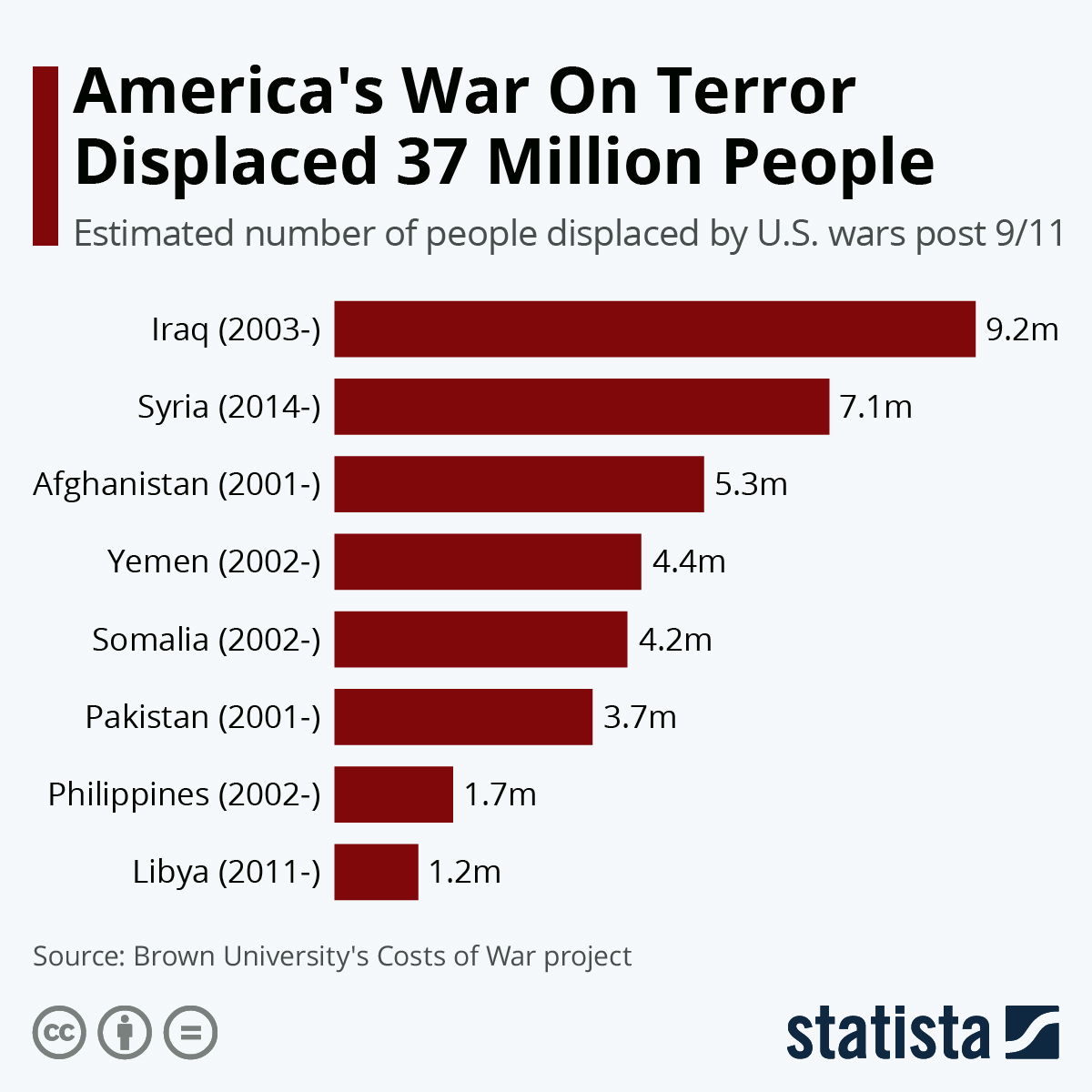
Yet, as we reflect on the 24th anniversary of 9/11, a glaring question remains unanswered. Why are the lives of those killed on September 11, 2001 deemed more worthy of remembrance than the hundreds of thousands—possibly millions—of innocent civilians, predominantly Muslim, killed in the US-led wars in Afghanistan, Iraq, and the broader “War on Terror“? This selective mourning reveals a troubling double standard and Western societal prejudice that disregards the humanity of these forgotten victims and perpetuates a cycle of violence that has made the world less safe due to US actions and policies.
The 9/11 attacks were a profound tragedy, a moment of collective trauma that reshaped global politics. The horror of that day—planes crashing into towers, buildings collapsing, and lives extinguished—remains vivid for those who witnessed it, whether in person or through relentless news coverage. For Muslim communities, the attacks also sparked fear and foreboding, as they braced for the inevitable backlash.
Within months, the US launched its “War on Terror, “ a sprawling global military campaign that included the invasions of Afghanistan and Iraq, a years long campaign of drone strikes in Pakistan, Yemen, Somalia and other nations, and other operations targeting suspected terrorists wherever they were situated. These actions, justified as a response to 9/11, have left a trail of devastation, with civilian deaths exponentially surpassing the toll of the original 9/11 attacks. Yet, the victims of these wars—men, women, and children who experienced their own terror from bombs, bullets, and missiles fired by the militaries of the US and its allies—are rarely acknowledged, let alone commemorated, in Western society.
The horrendous civilian death toll
The scale of civilian casualties in the War on Terror is staggering. A 2006 study by Johns Hopkins University, published in The Lancet, estimated that 655,000 Iraqis had died by the middle of the year as a direct result of the US invasion, with later estimates suggesting a death toll of up to 940,000. In Afghanistan, the Costs of War project at Brown University estimates over 400,000 civilian deaths, including those killed directly by conflict and indirectly through disease, malnutrition, displacement and destruction of societal infrastructure. Drone strikes, a hallmark of US counter-terrorism since 9/11, have killed at least 25,835 civilians across Afghanistan, Pakistan, Yemen, and Somalia, according to data from the Bureau of Investigative Journalism. Additional analysis, put the cumulative death toll in all of America ‘s post 9/11 wars at between 4.5 million and 4.7 million, a number more than 1,500 times greater than the casualties of September 11, 2001.
These numbers represent not just lives lost but families wiped out, communities destroyed, societies shredded, and futures erased. Each death carried the same weight of terror as those felt by the victims of 9/11, yet these people, who also had loved ones, remain largely invisible in Western memory.
The human cost is vividly illustrated by individual stories of loss. In 2003, Ali Ismail Abbas, a 12-year-old Iraqi boy, lost both arms when a US missile struck his family ‘s home near Baghdad due to faulty intelligence, killing his father and pregnant mother, his brother and 13 other members of his family. The attack also left third degree burns covering at least 35% of his body.
In 2002, a US B-52 bomber dropped a bomb that obliterated a wedding party. What should have been a joyous occasion resulted in the death of up to 250 civilians. Then US forces launched a two-hour assault on the location with additional bombs and an AC-130 gunship after mistaking the wedding guests‘ celebratory gunshots into the air as hostile fire, and raining hell down on the wedding venue.
In October 2012, Momina Bibi, a 67-year-old Pakistani grandmother, was killed by a US drone strike while picking vegetables with her two grandchildren, who were also injured. There were no military targets nearby, and she and the children were clearly visible in the field and could not have been mistaken for insurgents. Her son, Rafiq ur Rehman, a primary school teacher appeared at a hearing on Capitol Hill with his children, Zubair (13), and Nabila (9), and through a translator said, “Nobody has ever told me why my mother was targeted that day."
In August 2021, a US drone strike in a residential area of Kabul killed ten members of an Afghan family, including seven children, again due to faulty intelligence. The youngest victims of the attack were two 2-year-old girls who were in a car that was targeted. Neighbours who rushed to help put out the fire resulting from the attack described body parts strewn around the site of the airstrike. At a funeral held later family members shouted "Death to America."
These are only a handful of incidents among tens of thousands across Afghanistan, Iraq, Pakistan, Somalia, and Yemen, revealing a pattern of reckless disregard for civilian lives by the US. The euphemism “collateral damage” masks these preventable tragedies, leaving survivors with lasting physical and psychological scars, their grief intensified by the failure of the US to acknowledge or be held accountable for its actions. This silence betrays a deep-seated bias, devaluing Muslim and Arab lives and reinforcing systemic prejudice in Western consciousness.
Compensation for some victims and not others
In the year following the 9/11 attacks the US government established the 9/11 Victim Compensation Fund, disbursing $7.375 billion to victims and their families. In contrast, compensation for civilian victims of US military aggression has been rare and minimal, often limited to token payments or none at all. For example, families of drone strike victims in Pakistan and Yemen have received little to no redress, and when it has been offered, payments have been insultingly low compared to payouts for families of 9/11 victims.
Additionally, there are no memorials to honour the millions killed in Iraq or Afghanistan. And there are no Western leader delivering moving speeches at annual commemoration ceremonies to mourn the loss. This silence reinforces a hierarchy of grief, where American lives are deemed more valuable than those of Muslim civilians in distant lands.
The consequences of this double standard extend far beyond moral failure, and impacts security and safety. America’s military response to 9/11 has made the world less safe, including for Americans. The wars in Afghanistan and Iraq destabilized the Middle East, fueling insurgencies and creating fertile ground for groups like ISIS.
Civilian deaths, seen merely as “collateral damage,” dehumanizes Arab and Muslim populations and leads to the radicalization of families and communities who lost loved ones to attacks by the US or its allies, in turn creating cycles of revenge. The 2013 testimony before Congress by the son and children of the Pakistani grandmother killed by a US drone highlights how such strikes breed resentment, pushing survivors toward extremism.
Travelling Americans also face heightened risks abroad, as the actions of their government have eroded goodwill in many nations. The Costs of War project estimates that the War on Terror has cost over $8 trillion, surpassing the cost of World War Two when adjusted for inflation, and yet it has failed to eliminate terrorism, and instead spread political instability and created breeding grounds for terrorists in the Middle East and across North Africa.
The erosion of civil liberties
This selective mourning has also perpetuated a cycle of anti-Arab racism and Islamophobia that continues to haunt Muslim communities. In addition, post-9/11 policies, such as the Patriot Act in the US and similar laws in Canada and Europe, eroded civil liberties, and disproportionately targeted Muslims. These measures, often justified under the banner of “national security,” have planted the seeds of distrust and alienation, damaging the fabric of Western societies, and further marginalized Muslim populations. The lack of acknowledgement for the victims of US wars has also reinforced the narrative that Arab and Muslim lives are expendable, emboldening right-wing rhetoric that vilified entire communities for the actions of a few. This dehumanization not only undermines global solidarity but also hinders efforts to address the root causes of terrorism, such as oppression and foreign intervention (primarily by the US) into the politics of other nations.
To break this cycle, we must expand the scope of 9/11 remembrance to include all victims of terrorism, whether perpetrated by non-state actors or states. The terror felt by an Afghan, Pakistani or Yemeni family obliterated by a drone strike is no less real than that experienced by those who were in the Twin Towers or on the passenger jets used as missiles. A global day of remembrance for all victims of terrorism could serve as a powerful gesture of united humanity, acknowledging the shared suffering of those affected by violence. Such an initiative would require Western leaders to confront uncomfortable truths about the roles of their nations in perpetuating terror, including the war crimes committed in Iraq and Afghanistan. It would also demand accountability, such as prosecuting those responsible for illegal wars and ensuring meaningful compensation for victims of US actions.
Moreover, recognizing these forgotten victims could help dismantle the narrative of American exceptionalism that underpins the War on Terror. By valuing all lives equally, we can challenge the notion that Western suffering is uniquely worthy of mourning. This shift could foster dialogue and reconciliation, reducing the resentment that fuels extremism. For example, acknowledging the pain of families like that of Momina Bibi and providing restitution could demonstrate a commitment to justice, potentially mitigating the radicalization of their communities. It would also signal to the world’s two billion Muslims that their humanity matters, countering the Islamophobia that has poisoned global relations since 9/11.
Until we confront this double standard, the legacy of 9/11 will remain incomplete. Commemorating only American victims while ignoring the hundreds of thousands killed by the US and it allies perpetuates a narrative that dehumanizes Arab and Muslim lives and excuses state terrorism. It is time to expand our moral imagination and mourn all who have suffered, and to work toward a world where no innocent life is deemed expendable. Only then can we claim to honour the true cost of 9/11 and build a future where peace, not vengeance, prevails.
Yet, as we reflect on the 24th anniversary of 9/11, a glaring question remains unanswered. Why are the lives of those killed on September 11, 2001 deemed more worthy of remembrance than the hundreds of thousands—possibly millions—of innocent civilians, predominantly Muslim, killed in the US-led wars in Afghanistan, Iraq, and the broader “War on Terror“? This selective mourning reveals a troubling double standard and Western societal prejudice that disregards the humanity of these forgotten victims and perpetuates a cycle of violence that has made the world less safe due to US actions and policies.
The 9/11 attacks were a profound tragedy, a moment of collective trauma that reshaped global politics. The horror of that day—planes crashing into towers, buildings collapsing, and lives extinguished—remains vivid for those who witnessed it, whether in person or through relentless news coverage. For Muslim communities, the attacks also sparked fear and foreboding, as they braced for the inevitable backlash.
Within months, the US launched its “War on Terror, “ a sprawling global military campaign that included the invasions of Afghanistan and Iraq, a years long campaign of drone strikes in Pakistan, Yemen, Somalia and other nations, and other operations targeting suspected terrorists wherever they were situated. These actions, justified as a response to 9/11, have left a trail of devastation, with civilian deaths exponentially surpassing the toll of the original 9/11 attacks. Yet, the victims of these wars—men, women, and children who experienced their own terror from bombs, bullets, and missiles fired by the militaries of the US and its allies—are rarely acknowledged, let alone commemorated, in Western society.
The horrendous civilian death toll
The scale of civilian casualties in the War on Terror is staggering. A 2006 study by Johns Hopkins University, published in The Lancet, estimated that 655,000 Iraqis had died by the middle of the year as a direct result of the US invasion, with later estimates suggesting a death toll of up to 940,000. In Afghanistan, the Costs of War project at Brown University estimates over 400,000 civilian deaths, including those killed directly by conflict and indirectly through disease, malnutrition, displacement and destruction of societal infrastructure. Drone strikes, a hallmark of US counter-terrorism since 9/11, have killed at least 25,835 civilians across Afghanistan, Pakistan, Yemen, and Somalia, according to data from the Bureau of Investigative Journalism. Additional analysis, put the cumulative death toll in all of America ‘s post 9/11 wars at between 4.5 million and 4.7 million, a number more than 1,500 times greater than the casualties of September 11, 2001.
These numbers represent not just lives lost but families wiped out, communities destroyed, societies shredded, and futures erased. Each death carried the same weight of terror as those felt by the victims of 9/11, yet these people, who also had loved ones, remain largely invisible in Western memory.
The human cost is vividly illustrated by individual stories of loss. In 2003, Ali Ismail Abbas, a 12-year-old Iraqi boy, lost both arms when a US missile struck his family ‘s home near Baghdad due to faulty intelligence, killing his father and pregnant mother, his brother and 13 other members of his family. The attack also left third degree burns covering at least 35% of his body.
In 2002, a US B-52 bomber dropped a bomb that obliterated a wedding party. What should have been a joyous occasion resulted in the death of up to 250 civilians. Then US forces launched a two-hour assault on the location with additional bombs and an AC-130 gunship after mistaking the wedding guests‘ celebratory gunshots into the air as hostile fire, and raining hell down on the wedding venue.
In October 2012, Momina Bibi, a 67-year-old Pakistani grandmother, was killed by a US drone strike while picking vegetables with her two grandchildren, who were also injured. There were no military targets nearby, and she and the children were clearly visible in the field and could not have been mistaken for insurgents. Her son, Rafiq ur Rehman, a primary school teacher appeared at a hearing on Capitol Hill with his children, Zubair (13), and Nabila (9), and through a translator said, “Nobody has ever told me why my mother was targeted that day."
In August 2021, a US drone strike in a residential area of Kabul killed ten members of an Afghan family, including seven children, again due to faulty intelligence. The youngest victims of the attack were two 2-year-old girls who were in a car that was targeted. Neighbours who rushed to help put out the fire resulting from the attack described body parts strewn around the site of the airstrike. At a funeral held later family members shouted "Death to America."
These are only a handful of incidents among tens of thousands across Afghanistan, Iraq, Pakistan, Somalia, and Yemen, revealing a pattern of reckless disregard for civilian lives by the US. The euphemism “collateral damage” masks these preventable tragedies, leaving survivors with lasting physical and psychological scars, their grief intensified by the failure of the US to acknowledge or be held accountable for its actions. This silence betrays a deep-seated bias, devaluing Muslim and Arab lives and reinforcing systemic prejudice in Western consciousness.
Compensation for some victims and not others
In the year following the 9/11 attacks the US government established the 9/11 Victim Compensation Fund, disbursing $7.375 billion to victims and their families. In contrast, compensation for civilian victims of US military aggression has been rare and minimal, often limited to token payments or none at all. For example, families of drone strike victims in Pakistan and Yemen have received little to no redress, and when it has been offered, payments have been insultingly low compared to payouts for families of 9/11 victims.
Additionally, there are no memorials to honour the millions killed in Iraq or Afghanistan. And there are no Western leader delivering moving speeches at annual commemoration ceremonies to mourn the loss. This silence reinforces a hierarchy of grief, where American lives are deemed more valuable than those of Muslim civilians in distant lands.
The consequences of this double standard extend far beyond moral failure, and impacts security and safety. America’s military response to 9/11 has made the world less safe, including for Americans. The wars in Afghanistan and Iraq destabilized the Middle East, fueling insurgencies and creating fertile ground for groups like ISIS.
Civilian deaths, seen merely as “collateral damage,” dehumanizes Arab and Muslim populations and leads to the radicalization of families and communities who lost loved ones to attacks by the US or its allies, in turn creating cycles of revenge. The 2013 testimony before Congress by the son and children of the Pakistani grandmother killed by a US drone highlights how such strikes breed resentment, pushing survivors toward extremism.
Travelling Americans also face heightened risks abroad, as the actions of their government have eroded goodwill in many nations. The Costs of War project estimates that the War on Terror has cost over $8 trillion, surpassing the cost of World War Two when adjusted for inflation, and yet it has failed to eliminate terrorism, and instead spread political instability and created breeding grounds for terrorists in the Middle East and across North Africa.
The erosion of civil liberties
This selective mourning has also perpetuated a cycle of anti-Arab racism and Islamophobia that continues to haunt Muslim communities. In addition, post-9/11 policies, such as the Patriot Act in the US and similar laws in Canada and Europe, eroded civil liberties, and disproportionately targeted Muslims. These measures, often justified under the banner of “national security,” have planted the seeds of distrust and alienation, damaging the fabric of Western societies, and further marginalized Muslim populations. The lack of acknowledgement for the victims of US wars has also reinforced the narrative that Arab and Muslim lives are expendable, emboldening right-wing rhetoric that vilified entire communities for the actions of a few. This dehumanization not only undermines global solidarity but also hinders efforts to address the root causes of terrorism, such as oppression and foreign intervention (primarily by the US) into the politics of other nations.
To break this cycle, we must expand the scope of 9/11 remembrance to include all victims of terrorism, whether perpetrated by non-state actors or states. The terror felt by an Afghan, Pakistani or Yemeni family obliterated by a drone strike is no less real than that experienced by those who were in the Twin Towers or on the passenger jets used as missiles. A global day of remembrance for all victims of terrorism could serve as a powerful gesture of united humanity, acknowledging the shared suffering of those affected by violence. Such an initiative would require Western leaders to confront uncomfortable truths about the roles of their nations in perpetuating terror, including the war crimes committed in Iraq and Afghanistan. It would also demand accountability, such as prosecuting those responsible for illegal wars and ensuring meaningful compensation for victims of US actions.
Moreover, recognizing these forgotten victims could help dismantle the narrative of American exceptionalism that underpins the War on Terror. By valuing all lives equally, we can challenge the notion that Western suffering is uniquely worthy of mourning. This shift could foster dialogue and reconciliation, reducing the resentment that fuels extremism. For example, acknowledging the pain of families like that of Momina Bibi and providing restitution could demonstrate a commitment to justice, potentially mitigating the radicalization of their communities. It would also signal to the world’s two billion Muslims that their humanity matters, countering the Islamophobia that has poisoned global relations since 9/11.
Until we confront this double standard, the legacy of 9/11 will remain incomplete. Commemorating only American victims while ignoring the hundreds of thousands killed by the US and it allies perpetuates a narrative that dehumanizes Arab and Muslim lives and excuses state terrorism. It is time to expand our moral imagination and mourn all who have suffered, and to work toward a world where no innocent life is deemed expendable. Only then can we claim to honour the true cost of 9/11 and build a future where peace, not vengeance, prevails.
© 2025 The View From Here. © 2025 Fareed Khan. All Rights Reserved.


.jpg)
