Showing posts with label US attacks Iran. Show all posts

2026-04-23

Donald Trump: A cancer upon the world that needs to be dealt with

It wouldn't be shocking to say that many global leaders hope that nature takes it course and Trump succumbs to age or a health issue that removes him from office and this world permanently.  
 
By Fareed Khan 
A version of this can be found on Substack.

Donald Trump is a walking catastrophe of a human being, a man so devoid of basic decency, empathy, or any shred of genuine humanity that his very existence feels like an insult to the human species. In essence, he is a cancer upon the world.

This is not hyperbole. It is the cold, observable truth about a narcissistic sociopath, a man-child whose every action radiates selfishness, megalomania, cruelty, and a chilling indifference to the suffering his words and actions leave in his wake. He doesn’t care about how his behaviour harms people—never has, never will.

To Trump, human beings are props to be used for his personal benefit, or obstacles to be overcome in the endless melodrama of his own ego. The pain and suffering, the death, the economic ruin, and the democratic erosion he has caused aren’t unfortunate side effects, they are foreseeable results that any truly intelligent person with an ounce of humanity could predict. But, ultimately, to him they are irrelevant, because nothing registers on his brain unless it flatters him and boosts his ego, or threatens his fragile, bloated self-image.

Look at the Middle East right now, teetering on the edge of a catastrophic war that could claim millions of lives. Before February 28 there was a tense peace among the nations of the region and oil was flowing freely through the Strait of Hormuz. But Trump’s reckless actions, launching an
illegal and unprovoked war against Iran, in conjunction with Israel, his political posturing, his genocidal rhetoric, and his dangerous game of brinkmanship—culminating in a blockade of the Strait—are shoving the region toward chaos, and could drag in other nations affected by the crisis his actions have created. Oil flows have been disrupted, global supply chains strangled, and innocent people killed by American and Israeli attacks—all because of one man’s irrational, impulsive bullying style of “diplomacy”, and because his fragile ego demands attention.

Trump doesn’t lose sleep over the mothers
burying children killed by US bombs, refugees fleeing US-Israeli attacks, or people being unable to afford food. Why would he? Compassion isn’t part of his emotional vocabulary. He’s too busy smirking in front of cameras, turning foreign policy into a reality TV spectacle, while real human lives are upended. His lack of humanity and his embrace of what can only be termed evil aren’t flaws he tries to hide, it’s who he is to the core. He revels in strength as a form of domination, never as a way to protect the vulnerable or uplift the weak. The suffering of innocents? Mere collateral damage in his quest for personal victory at all costs.

And then there is the economy. Trump’s bull-in-a-china-shop antics are barrelling the world towards a
global recession, stoking inflation, and will push interest rates higher with every chaotic tweet and every effort to make the Iranians succumb to his unconditional demands. Families worldwide are already feeling the squeeze—sky high gas prices, higher food prices, layoffs as businesses try to cut rising costs, and plans for the future put on hold due to uncertainty. Yet he charges ahead, indifferent to how his actions sow chaos and misery in the lives of ordinary people. This is the same man who, in his first term as president, displayed a chilling indifference to the fragile interconnectedness of our world, deliberately weaponizing personal vendettas against his political enemies in ways that left a trail of devastation among the vulnerable—both at home and abroad.

Trump doesn’t care about the single mother struggling to feed her kids because grocery costs spiked. He doesn’t care about the factory worker whose livelihood vanishes in a trade war he started. To him, humanity and compassion are not virtues but fatal weaknesses—signs of inferiority to be exploited and crushed. Those who dare display empathy deserve nothing less than public humiliation, served up like sacrificial lambs to feed his endless hunger for dominance. He mocks the merciful, belittles the decent, and gazes upon them with the cold contempt of a tyrant surveying peasants, reminding us all that in his dark vision of America, kindness is treason and strength means only the ruthless exercise of raw power.

The world is
utterly sick of Donald Trump. From European capitals to Asian financial hubs, from Latin American streets to African villages feeling the indirect shocks of his actions, people watch the circus he has created with a mixture of horror and exhaustion. His antics aren’t just embarrassing anymore, they are dangerous. A superpower led by a man with the emotional maturity of a spoiled toddler, armed with nuclear codes and the world’s largest military, is a recipe for global instability and disarray far beyond what we are already enduring.

It would not be shocking to say that many global leaders secretly hope that nature takes it course and Trump succumbs to age or a health issue that removes him from office and this world permanently. They likely hope that this exhausting chapter in world history ends before the damage Trump has inflicted becomes irreversible. And they are likely joined by tens of millions around the world who feel similarly. It’s safe to say these would be the sentiments of people who are exhausted, who see one man-child holding the planet hostage, and who can’t wait until the Trumpian nightmare ends.

Americans who still possess a conscience—those who didn’t vote for him and those who now regret their vote—must confront the ugly reality. Under Trump, there is
no politics as usual. What America faces is the outcome of a collective insanity, which has been building for years, that placed in the presidency a man who is dismantling their democracy brick by brick, while torching the world order that preserved a fragile global peace for eighty years. His pathological personality, serial lying, bombast, and dangerous rhetoric are not mere quirks. They are weaponized personality disorders that are laying waste to the very foundations of the imperfect civil society built from the ashes of World War Two.

This is
a man who lies every time his lips move because truth threatens his fragile ego. Fact-checkers have tallied thousands of lies whenever he has spoken publicly or posted on social media, yet he doubles down with that signature smirk, daring anyone to call him out. His amorality is disgusting and dangerous. He praises dictators, cozies up to authoritarians, and treats democratic norms like inconvenient suggestions. Ethics? Accountability? According to Trump these are for suckers. He operates on pure transactional self-interest, where loyalty is demanded, and betrayal is met with venomous rage.

The truth is that the world is utterly sick of Donald Trump’s face, his grating voice, and that perpetual, menacing sneer that drips with entitlement and barely concealed insecurity. This is a man who has openly mocked the disabled, ridiculed war heroes, and degraded women through vulgar, boastful tirades that expose a vicious misogyny and a self-loathing he projects onto the entire world. His racism and bigotry are no longer whispered dog whistles but brazen, inflammatory rallying cries that deliberately summon humanity’s darkest tribal impulses. Trump channels a chilling, Hitlerian vision of dominance—a “fourth Reich” fantasy in which a white supremacist-tinged America demands global submission to him and his cabal of billionaire sycophants, who feed their insatiable greed and lust for unchecked power. He surrounds himself with loyal enablers who eagerly amplify his hatred, mainstream conspiracy theories, and display open contempt for every democratic institution that dares restrain his authoritarian ambitions. How can any decent person witness this rising threat without feeling a profound and urgent sense of revulsion?

Democracy in the US is itself
under threat because to Trump, it’s not a sacred system of checks, balances, and peaceful transitions. It is a tool to be bent or broken when it doesn’t deliver what he craves. His actions are not just unravelling American democracy, but also the fragile post-World War Two order, pushing alliances to the brink of fracture, and inviting adversaries to exploit the global divisions he is creating.

The 33% of eligible American voters who knowingly returned Donald Trump to power—fully aware of the
Access Hollywood tape, the endless scandals, the racial incitement, and his pathological lying—bear a heavy responsibility. The MAGA crowd decided that character didn’t matter, that racism, misogyny, and raw amorality were acceptable in a leader rather than disqualifiers. Their blind loyalty has created a frightening cult of personality that prizes grievance over governance and spectacle over substance, normalizing the abnormal, and handing the nation’s steering wheel to a drunk driver.

Americans who care about their nation—truly care, beyond partisan tribalism—must come together now to halt this madman before he destroys what’s left of their democracy, not to mention, the impact that unravelling of the US will have globally. It falls to them to rise above the noise and chaos that Trump peddles, and demand better. This isn’t about right versus left, it’s about sanity versus insanity, humanity versus nihilism.

The people of the US must unite across divides—progressives, moderates, conservatives who still believe in democracy and principles over personality. They must organize, vote, speak out, hold the people who enable Trump accountable. They must pressure Republican congressional representatives and senators to prioritize country over cult, lest the nation that is celebrating the 250th anniversary of its founding this year, comes apart at the seams. The world cannot afford three more years of the global danger Trump represents. His actions don’t just damage America, they endanger the entire world by amplifying irrationality and instability.

Donald Trump doesn’t represent America’s best. He enables its worst. He must be rejected, constrained, and if possible arrested, tried and convicted, if Americans are to reclaim the democracy he treats as his personal playground. Before it’s too late, before the pain spreads further, before the world pays an even steeper price, for one man’s profound lack of soul and dearth of humanity.

This maniac must be stopped. Americans who love their nation more than they fear discomfort must act decisively. The suffering Trump has caused and could yet unleash demands nothing less.


© 2026 The View From Here. © 2026 Fareed Khan. All Rights Reserved.

2026-04-13

US-Israeli aggression has destabilized the Middle East and turned it into a powder keg

Through their actions, the United States and Israel have transformed the Middle East into a far more dangerous place, and established themselves as the biggest destabilizing force in the region.

By Fareed Khan 
A version of this can be found on Substack.

“To initiate a war of aggression, therefore, is not only an international crime; it is the supreme international crime differing only from other war crimes in that it contains within itself the accumulated evil of the whole.”

These words, pronounced by the International Military Tribunal at Nuremberg in 1946, were meant to serve as an eternal indictment of aggressive war and a bulwark against the very atrocities it inevitably unleashes. They declared that the crime of starting an unprovoked conflict carries within it every subsequent horror—civilian slaughter, shattered societies, refugee crises, economic ruin, and the slow erosion of global order.


Today, in the wake of the collapse of the two-week ceasefire with Iran announced by President Donald Trump on April 7, 2026, Nuremberg’s verdict echoes with terrifying clarity. The agreement was precarious from the moment it was signed—a cynical pause designed not to end hostilities but to buy time for the continuation of a war of aggression launched by the United States and Israel on February 28. That original assault, and every violation of international law that has followed—including the breakdown of Pakistan-mediated peace talks in Islamabad over the weekend and the subsequent US threats to blockade the Strait of Hormuz to all shipping traffic—embodies the “accumulated evil” Nuremberg warned against. The ceasefire’s swift failure was not an unfortunate accident; it was the predictable consequence of a policy rooted in lawlessness, hubris, and an unshakable commitment to Israeli impunity.

Almost immediately after Trump’s announcement, Israeli forces expanded their strikes deep into Lebanon, hitting more than 100 targets in a single ten-minute barrage across commercial and residential districts of central Beirut. Lebanese health authorities now report civilian deaths climbing rapidly, with more than 280 killed over a 48 hour period alone—the highest single-day toll in the Israel-Hezbollah war—along with hundreds wounded and the overall displacement of more than 1.7 million Lebanese from the southern part of the country. In direct response, Iran once again closed the Strait of Hormuz and imposed tolls on shipping. The fragile truce, which Iranian officials explicitly insisted include an immediate end to the war in Lebanon, lies in ruins. However, Israel refuses to recognize that Lebanon was ever part of the agreement, exposing the selective and self-serving nature of the so-called peace deal.

This breach was not an aberration but the expected outcome of a pattern of bad faith negotiating that has defined Israeli and American policy in the region for years. Israel has violated every ceasefire it has ever agreed to—both in the recent past two and a half years and in the decades prior—including the so-called ceasefire with Hamas signed in October 2025, which it shattered with near-daily attacks, killing hundreds of Palestinians and racking up more than 2,000 documented violations by March 2026. The same pattern has played out repeatedly in Lebanon, where Israel stands accused of thousands of breaches of the 2024 ceasefire agreement

Netanyahu’s government and the Trump administration now claim the US-Iran truce “does not cover Lebanon,” but that self-serving caveat was never accepted by Tehran. The ceasefire was never meant to hold; it was merely a temporary pause in a war of aggression that Washington and Jerusalem launched—an operation that has already exacted a devastating human and strategic toll and that carries, in Nuremberg’s precise language, the accumulated evil of all the atrocities that have followed. 

The original assault on February 28 remains the root of the entire catastrophe. On that day, US and Israeli forces unleashed coordinated airstrikes across Iran in what was dubbed Operation Epic Fury. The attacks assassinated Iran’s Supreme Leader Ali Khamenei and other senior officials, bombed nuclear and military sites, and indiscriminately killed civilians, including more than 165 girls and staff at an elementary school. There was no armed attack by Iran that could justify such action under Article 51 of the UN Charter, given that negotiations over Iran’s nuclear program were still active at the time. There was no imminent threat, no UN Security Council authorization, and no lawful claim of self-defence could be made by either the US or Israel. The strikes constituted a classic war of aggression—the “supreme international crime” condemned at Nuremberg as the crime that contains within itself the accumulated evil of all subsequent atrocities.

The legal violations are clear and damning. Article 2(4) of the UN Charter is unequivocal declaring that states must refrain from the threat or use of force against the territorial integrity or political independence of any other state. The US-Israeli operation shattered that prohibition in the most flagrant manner. Legal scholars have repeatedly affirmed that pre-emptive wars of choice, launched while diplomacy was still underway, violate the post-1945 international order that was designed precisely to prevent such acts of naked aggression. The subsequent bombing of schools, hospitals, and civilian infrastructure only compounded the original crime. International humanitarian law—the Geneva Conventions and Additional Protocol I—forbids attacks on objects indispensable to civilian survival and demands strict distinction between military and civilian targets. Deliberate or reckless strikes on health centres and schools are war crimes under any reasonable interpretation of the law. 

Compounding the legal atrocities is the incendiary rhetoric from the White House itself. Trump’s own social-media rants have escalated the criminality into genocidal territory. He threatened to make Iran “live in Hell,” promised attacks on power plants and bridges, and declared that “a whole civilization will die tonight, never to be brought back again.” Under Article II of the 1948 Genocide Convention, such statements can be seen as telegraphing intent to destroy, in whole or in part, a national or ethnic group by inflicting conditions of life calculated to bring about its physical destruction. Threatening to annihilate an ancient civilization—its people, culture, and millennia-old heritage—meets that legal threshold. Experts have already labelled these declarations as potential incitement to genocide and war crimes

The fact is that the crisis in the Strait of Hormuz was entirely manufactured by the US-Israeli initial act of aggression. Before February 28, commercial shipping was moving normally through the waterway that carries one-fifth of global oil and gas. Only after the bombs began falling did Iran assert control, reduce shipping volume, and begin collecting toll from ships that were allowed to pass. The closure was defensive and in reaction to US-Israeli aggression, not provocative. Iran’s re-closure of the waterway this week is the predictable consequence of Israel’s violation of the ceasefire’s Lebanon provisions and the mounting civilian slaughter there. 

Each additional provocation only deepens global sympathy for Iran and erodes Washington’s moral authority. This latest escalation follows directly on the breakdown of Pakistan-mediated peace talks in Islamabad, which collapsed without agreement over the weekend despite offering a genuine path to de-escalation. In the wake of that failure, the United States has now threatened a naval blockade of the Strait of Hormuz to all shipping traffic—an act of economic warfare that further militarizes the chokepoint and exposes the hollowness of any American commitment to peace. 

The human and strategic costs of this military aggression are already staggering beyond imagination. Civilian deaths inside Iran exceed 2,000. Power plants, bridges, and homes remain in the cross hairs, and the global economic costs are mounting, with a potential to plunge 32 million in to poverty, and create a global recession Additionally, the latest Lebanese massacres—more than 280 dead in just two days—demonstrates that Israel has no intention of honouring even the limited truce it signed. Should the conflict reignite fully, the “accumulated evil” of the initial aggression will metastasize. Hezbollah, Iraqi militias, and the broader “Axis of Resistance” will be drawn in. Refugee flows, oil-price shocks, direct retaliation against US bases, and proxy wars across multiple borders would follow. 

The Persian Gulf and the Levant could erupt into a conflagration dwarfing any recent Middle East conflict, pulling in surrounding nations—Iraq, Syria, Saudi Arabia, the Gulf states—in a vortex of retaliation none of them sought. This avoidable war with Iran could easily lead to a wider regional war with some analysts predicting it could even lead to World War 3, as alliances are tested and superpowers are drawn into the fray through cascading proxy conflicts and economic desperation.

Through their actions, the United States and Israel have transformed the Middle East into a far more dangerous place, and established themselves as the biggest destabilizing force in the region. Rather than acting as forces for stability or sincerely committing to peace, their unprovoked aggression has fuelled cycles of violence, resentment, and instability that threaten to engulf the entire region and far beyond. The war with Iran was completely avoidable, yet Washington and Jerusalem opted for missiles and bombs over bargaining in a display of arrogance that has now destabilized multiple borders simultaneously. This choice has not only violated international law but has also sacrificed the safety and lives of tens of millions of innocents on the altar of America’s unequivocal support to its genocidal Israeli ally. 

The main victims of this unholy alliance have been Palestinians, Arabs, and Muslims, whose lives hold little value in the pursuit of Israeli security objectives and America’s goal of controlling Middle-East oil. From the relentless violations and civilian slaughter in Gaza to the carnage in Lebanon and the war against Iran, these populations have borne the brunt of the suffering, with their homes destroyed, families torn apart, and futures obliterated to appease a rogue terrorist nation that operates with impunity while the US provides diplomatic cover, arms, and political support at every turn.

The evils of war are not abstract concepts to be debated in think tanks. They are visceral, devastating realities that destroy lives, communities, and the fragile fabric of international trust. Wars bring indiscriminate death to children and civilians, widespread population displacements that creates generations of refugees, economic collapse that ripples across continents, and a legacy of hatred that poisons societies for decades. 

In the current scenario American and Israeli actions pose an existential global threat, undermining the very foundations of global peace and security that have held since 1945. By flouting the UN Charter, committing what amount to war crimes, and declaring genocidal intent (as Israel actually commits genocide), they have set a dangerous precedent that could encourage other nations to engage in similar acts of aggression to achieve their geopolitical goals, leading to a breakdown of the global order and the very real prospect of uncontrollable escalation. 

Additionally, the risk of a wider war is not hypothetical. It is imminent, with the potential to draw the world into a conflict of unprecedented scale involving energy chokepoints, proxy armies, and nuclear-armed states. There is also the reality that Trump’s words and actions have thoroughly destroyed America’s reputation on the world stage. Once seen as a leading proponent of diplomacy and the rule of law, the US under Trump is now seen as unreliable, impulsive, belligerent and dangerous. His threats and the childish rampage that characterized his approach to Iran have marked what many describe as the end of the American century, leaving even its closest allies questioning whether they can trust Washington anymore. The world will ultimately pay for Trump’s Iran mess, as global stability hangs in the balance due to his reckless policies and the resulting chaos. A nation that even its allies don’t trust any more is a nation adrift, its moral authority in tatters and its alliances fraying at the seams. 

Canada’s response has been characteristically timid, reflecting the broader erosion of trust among traditional partners. Prime Minister Mark Carney has issued vague calls for “respect for international law and human rights” but has offered no specific condemnation of either Trump’s genocidal threats or Israel’s criminal actions either in Gaza, Iran or Lebanon. Ottawa appears content with platitudes about “deep concern” and “calls for restraint,” prioritizing economic and security ties with Washington over moral leadership. History will judge whether such silence amounts to complicity in the face of clear violations. 

In the end, the shattered ceasefire changes nothing fundamental. The war of aggression began on February 28, and its criminality persists. Civilian infrastructure still lies in ruins; hospitals and schools still bear the scars of illegal attacks. Genocide still continues in Gaza, while additional genocidal rhetoric still emanates from the White House. 

The Strait of Hormuz remains a flash point of America’s own making. And the risk of a wider war—engulfing neighbouring states in uncontrollable escalation—looms larger than ever. If the international community allows this precedent to stand, the UN Charter and the UN itself become meaningless, and Nuremberg’s verdict becomes a historical footnote. The greater danger is that Israeli sabotage of the ceasefire—coupled with the rising tide of Lebanese civilian deaths—will now be used as pretext for renewed attacks while the architects of the original aggression face no reckoning.

Only by naming the February 28 strikes, and every subsequent violation—including the collapse of mediated diplomacy and the provocative U.S. blockade threats—for what they are—an illegal, unprovoked war that has already produced war crimes and follows the example of the atrocities committed in the Gaza genocide—can we hope to avert the regional eruption that still threatens us all. The fault lies squarely with the United States and Israel. Until that reality is confronted through concrete international action, including accountability mechanisms that ensure no impunity for these aggressor nations, peace in the Persian Gulf and the Levant will remain a fragile and ultimately illusory hope. The Nuremberg principles demand nothing less: aggressors must face justice, or the accumulated evil of war will continue to consume us all.

© 2026 The View From Here. © 2025 Fareed Khan. All Rights Reserved.

2026-04-04

Trump’s Iran war speech revealed an American imperial crusade disguised as "defence"

With its war against Iran and other aggressions—Venezuela, Cuba, Greenland—the United States has shown itself to be the greatest threat to global peace and stability in 90 years.

By Fareed Khan 
A version of this can be found on Substack.
 
If anyone familiar with the history of the Middle East over the past 150 years had been thoughtfully absorbing President Donald Trump’s April 1, 2026, address to the nation, the words emanating from the screen would have transported them not to the present-day battlefield in Iran, but to the drawing rooms of 19th-century European chancelleries. There, kings and prime ministers justified the carving up of Africa at the Berlin Conference and the conquest of ancient Asian societies by invoking divine mandate and racial superiority.


This colonial mindset, once used to legitimize European domination over “uncivilized” peoples and their resources, has found a strikingly modern echo in Trump’s rhetoric. Beneath the boasts of military success and appeals to American strength lies the same underlying assumption: that certain racialized societies are inherently chaotic and backward, requiring the forceful hand of a superior power to impose order. The speech did not merely announce tactical victories; it revealed a deeper imperial logic that treats the Middle East as a theatre for great-power manoeuvring rather than a region of sovereign nations with millennia-old civilizations.


Trump’s triumphant declaration—that in just one month the US had destroyed Iran’s navy, reduced its air force to ruins, killed its leaders, and decimated the Islamic Revolutionary Guard Corps—read like a dispatch from a European viceroy announcing the subjugation of some “backward” colonial territory. He framed America as the indispensable force restoring order to a “fanatical regime” whose citizens have been chanting “Death to America” for decades, while congratulating troops on victories “like few people have ever seen before.” Yet the real barbarian in this picture is not Iran, a nation that has never invaded or attacked another sovereign state since long before the United States achieved independence. It is the United States itself—an agent of chaos and destruction that has destabilized the Middle East for generations in pursuit of its own geopolitical agenda and its enduring desire to control the region’s oil resources.

Trump’s speech was a masterclass in reductive
Orientalism, the kind Palestinian-American scholar Edward Said dissected decades ago in his critique, where he asserted that European and Western powers simplify and stereotype the region and its societies as primitive, irrational, violent, despotic, fanatic, and essentially inferior to Western societies, and thus in need of civilizing. The president cast Iran as the world’s “No. 1 state sponsor of terror,” responsible for everything from the 1983 Beirut barracks bombing to the October 7 Hamas attack, while glossing over America’s own violent and destructive history of intervention. From the overthrow of governments in Central America, to the 1953 coup against Iran’s democratically elected Prime Minister Mohammad Mossadegh, to the illegal Iraq War, and support for proxy wars that have turned the Middle East into a perpetual theatre of instability and conflict.

He boasted that the US is now “totally independent of the Middle East” thanks to his Venezuelan oil venture, yet insisted on remaining in the region “to help our allies.” This is the colonial logic laid bare. The US doesn’t’ need their resources, but will bomb their societies into submission to dictate who controls them. It mirrors the European scramble for Africa, where powers like Britain and France invoked civilizing missions while securing diamonds, rubber, and trade routes. Trump’s divine flourishes—”God bless” the astronauts and troops—echo the manifest destiny that sanctified earlier empires, now repackaged as another example of American military aggression and exceptionalism.

This war is not only completely illegal it is unnecessary and unprovoked, as there was no impending threat to the US, as verified by
intelligence leaks. In reality, it is the fulfillment of a fantasy Benjamin Netanyahu has harboured for nearly 40 years. For the better part of four decades, he has repeatedly claimed that Iran was weeks or months away from a nuclear bomb, using the spectre of a nuclearized Iran to lobby Washington for military action while sabotaging diplomacy at every turn. Wisely, no previous American president was reckless enough to listen to him and be sucked into a war of choice. They understood what Trump chose to ignore—subjugating Iran, a civilization with roots stretching back millennia, is impossible without catastrophic consequences. Previous administrations recognized the quagmire that would follow—endless insurgency, regional upheaval, and the risk of wider war. Trump, in his address, claimed to have corrected their “mistakes” by killing General Qassem Soleimani and tearing up Barack Obama’s nuclear deal. He presented these as acts of strength, but the truth is they were the opening salvos in a conflict that Netanyahu has long craved, that could be reminiscent of the US failure in Vietnam.

Additionally, Iran remains the last major Middle Eastern power that unequivocally supports freedom and justice for Palestinians. Through funding, arms, and diplomatic backing to groups resisting Israel’s occupation, Tehran has stood as a patron where other Middle East nations—Egypt, Syria, Libya, Iraq, Saudi Arabia—have been neutralized through diplomacy, economic incentives, or military action. Remove it, and Palestinians face a future of more Israeli subjugation, oppression, and occupation with no significant state-level ally left to help them achieve freedom.

Trump’s address barely mentioned Gaza, and didn’t even use the word “genocide”, focusing instead on Israel’s security as a core justification. This omission is deliberate, with the war serving as a grotesque distraction. As global eyes remain fixed on Iranian missile sites and oil tankers set ablaze, Israel continues its documented campaign of mass murder in the enclave—a genocide that the world has done nothing to halt. With attention diverted to the war against Israel presses forward unchecked, continuing the destruction of Gaza and the annihilation of its people.

The speech’s tone of bravado cannot mask the deeper truth—that the United States is showing itself to be the greatest threat to world peace and global economic stability in 90 years with its aggressions against Iran, (and Venezuela, Cuba, and Greenland). Trump claimed “core strategic objectives are nearing completion,” but the conflict has already exposed America’s limits. Despite its military might, the US has failed to achieve a swift victory. Iran’s resilience—its ability to absorb strikes and maintain asymmetric pressure—signals to Russia and China that Washington is not invincible despite its military power. If the mightiest military in the world cannot impose its will on a mid-tier adversary without calling for help from its NATO allies, Moscow and Beijing may calculate they could fare even better were a conflict to breakout with the US.

This war has not stabilized the region; instead it has brought the world palpably closer to World War Three, with supply chains fracturing, oil markets convulsing, and alliances realigning. Trump’s claim that “America is winning bigger than ever” rings hollow against the funerals at Dover Air Force Base and the American lives already lost.

As people listened to the address, they would likely be reminded of the casual racism that has underpinned American Middle East policy for decades. Defence Secretary Donald Rumsfeld under George W. Bush once reportedly dismissed Arabs as “lazy” because they sat atop too much oil. Texas Rep. Keith Self has claimed Islam is “stuck in the 8th century,” while Sen. Lindsey Graham quipped that anything starting with “Al” in the Middle East is bad news—oblivious that “algebra,” “alchemy,” and “algorithm” entered Western knowledge through Arab and Persian scholarship. Florida Rep. Randy Fine’s preference for a dog over a Muslim ignores Jalal ad-Din Rumi, the 13th-century Persian poet whose wisdom graces countless lives today, or the fact that Arab numerals underpin modern mathematics.

These stereotypes, as Said warned, erase the Middle Eastern society’s foundational contributions to human civilization. No one denies the region’s post-colonial challenges resulting from Western intervention—artificial borders drawn by former colonial masters, autocracies born of foreign meddling, and tensions exacerbated by external destabilization. But the notion that it requires Western “wisdom” imported at the barrel of a gun is the same conceit that justified colonial conquest. Iranians, like all peoples, deserve safety, freedom, and respect, not bombs justified by clichés of a “blood-stained land.”

Essentially, Trump’s address was more than just a war update. It was a declaration of imperial continuity. By aligning so brazenly with Netanyahu’s long-sought war against Iran, the US has cast itself as the latest in a line of powers convinced of their divine right to reshape ancient societies.

Iran did not seek this fight but it is prepared to
fight to the bitter end to preserve its society and sovereignty. The chaos we now see in the Persian Gulf originates in Washington’s endless quest for dominance. As gasoline prices continue to rise and the shadows of a wider war lengthen, Americans should ask--who is the true threat to civilization—the nation defending its people and territorial integrity against an unprovoked attack, or the superpower carving up the map once more?

History’s verdict on 19th-century colonialism is clear. The question is whether we will see that historic barbarism repeated, or finally reject it and then toss it onto the trash heap of history where it belongs.
  

© 2026 The View From Here. © 2025 Fareed Khan. All Rights Reserved.

2026-04-01

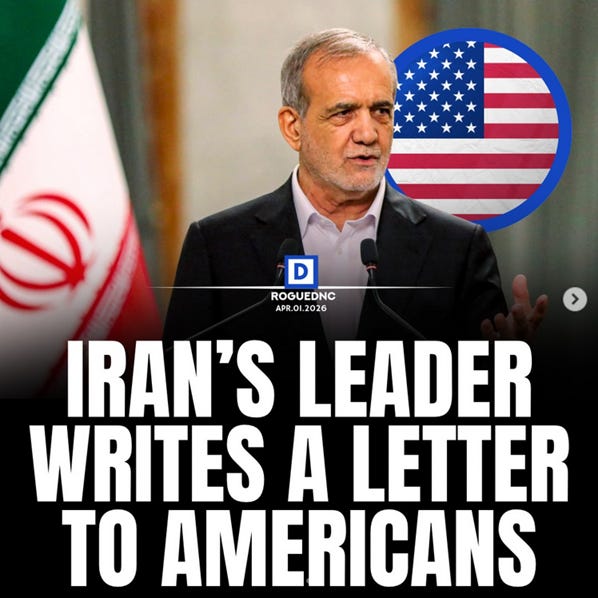
Iranian president speaks directly to the American people about US-Israeli war on Iran

Attacking Iran’s vital infrastructure directly targets the Iranian people. Beyond constituting a war crime, such actions carry consequences that extend far beyond Iran’s borders.

By Fareed Khan 
A version of this can be found on Substack.

BREAKING FROM IRAN: In a calculated diplomatic maneuver released just hours before President Donald Trump’s televised address to the American people, Iranian President Masoud Pezeshkian has issued an open letter directly to US citizens. The timing appears deliberate: an effort to get ahead of what Tehran anticipates will be a speech filled with justifications, distortions, and rationalizations for the ongoing US-led war against Iran.
Framing the conflict as one rooted in long-standing American aggression rather than any inherent Iranian threat, Pezeshkian urges Americans to look beyond what he describes as a “flood of distortions and manufactured narratives” emanating from Washington. He portrays the impending Trump address as likely to recycle familiar anti-Iranian talking points—depicting Iran as an existential danger, an aggressor, or a destabilizing force—while downplaying or ignoring the broader context of US interventions in the region that has made them and Israel the most destabilizing actors in the Middle East.

In the letter, Pezeshkian firmly denies that Iran poses any threat to the American people or harbours enmity toward them. He points out that Iran has never initiated aggression or sought expansion since the US achieved independence, positioning its actions instead as measured responses grounded in legitimate self-defence against foreign attacks. Portraying Iran as a menace, he argues, is inconsistent with both historical reality and observable facts, and stems more from America’s geopolitical and economic agenda rather than from genuine security concerns.

A central warning in the letter focuses on the human and global costs of US strikes. Pezeshkian highlights that any US or Israeli attacks on Iran’s vital infrastructure—including energy and industrial facilities—would be actions that directly target ordinary Iranian civilians. “Beyond constituting a war crime,” he states, “such actions carry consequences that extend far beyond Iran’s borders.” He questions whose interests are truly being served by prolonging the war, asking pointedly whether Trump’s “America First” agenda is genuinely guiding US policy or if other influences are at play, in a veiled reference to Israel.

By appealing straight to the American public over the heads of their government, Pezeshkian seeks to sow doubt about official US justifications, evoke shared humanity between the two peoples, and preempt any narrative that casts Iran solely as the villain. The letter blends defiance with a call for reflection, suggesting the path of confrontation is costlier and more futile than diplomacy, while reminding Americans of past US actions in Iran, such as the 1953 coup which overthrew a democratically elected government, installed Shah Mohammad Reza Pahlavi as its absolute ruler, and sowed the seeds of the 1979 Iranian Revolution, and decades of anti-American hostility by Iranians.

As Trump prepares to outline his administration’s stance on the conflict—potentially defending escalation, outlining military objectives, or framing the campaign as necessary for regional stability and American security—Pezeshkian’s message stands as a direct counter-narrative. It aims to frame the US as the escalator and aggressor, urging US citizens to scrutinize the rationales they are about to hear and consider the wider repercussions before further support solidifies behind continued hostilities.


FULL LETTER:

“To the people of the United States of America, and to all those who, amid a flood of distortions and manufactured narratives, continue to seek the truth and aspire to a better life:

Iran—by this very name, character, and identity—is one of the oldest continuous civilizations in human history. Despite its historical and geographical advantages at various times, Iran has never, in its modern history, chosen the path of aggression, expansion, colonialism, or domination. Even after enduring occupation, invasion, and sustained pressure from global powers—and despite possessing military superiority over many of its neighbors—Iran has never initiated a war. Yet it has resolutely and bravely repelled those who have attacked it.

The Iranian people harbor no enmity toward other nations, including the people of America, Europe, or neighboring countries. Even in the face of repeated foreign interventions and pressures throughout their proud history, Iranians have consistently drawn a clear distinction between governments and the peoples they govern. This is a deeply rooted principle in Iranian culture and collective consciousness—not a temporary political stance.

For this reason, portraying Iran as a threat is neither consistent with historical reality nor with present-day observable facts. Such a perception is the product of political and economic whims of the powerful—the need to manufacture an enemy in order to justify pressure, maintain military dominance, sustain the arms industry, and control strategic markets. In such an environment, if a threat does not exist, it is invented.

Within this same framework, the United States has concentrated the largest number of its forces, bases, and military capabilities around Iran—a country that, at least since the founding of the United States, has never initiated a war.

Recent American aggressions launched from these very bases have demonstrated how threatening such a military presence truly is. Naturally, no country confronted with such conditions would forgo strengthening its defensive capabilities. What Iran has done—and continues to do—is a measured response grounded in legitimate self-defense, and by no means an initiation of war or aggression.

Relations between Iran and the United States were not originally hostile, and early interactions between the Iranian and American people were not marred with hostility or tension. The turning point, however, was the 1953 coup d’état—an illegal American intervention aimed at preventing the nationalization of Iran’s own resources. That coup disrupted Iran’s democratic process, reinstated dictatorship, and sowed deep distrust among Iranians toward U.S. policies.

This distrust deepened further with America’s support for the Shah’s regime, its backing of Saddam Hussein during the imposed war of the 1980s, the imposition of the longest and most comprehensive sanctions in modern history, and ultimately, unprovoked military aggression—twice, in the midst of negotiations—against Iran.

Yet all these pressures have failed to weaken Iran. On the contrary, the country has grown stronger in many areas: literacy rates have tripled—from roughly 30% before the Islamic Revolution to over 90% today; higher education has expanded dramatically; significant advances have been achieved in modern technology; healthcare services have improved; and infrastructure has developed at a pace and scale incomparable to the past. These are measurable, observable realities that stand independent of fabricated narratives.

At the same time, the destructive and inhumane impact of sanctions, war, and aggression on the lives of the resilient Iranian people must not be underestimated. The continuation of military aggression and recent bombings profoundly affect people’s lives, attitudes, and perspectives. This reflects a fundamental human truth: when war inflicts irreparable harm on lives, homes, cities, and futures, people will not remain indifferent toward those responsible.

This raises a fundamental question: Exactly which of the American people’s interests are truly being served by this war? Was there any objective threat from Iran to justify such behaviour? Does the massacre of innocent children, the destruction of cancer-treatment pharmaceutical facilities, or boasting about bombing a country “back to the stone ages” serve any purpose other than further damaging the United States’ global standing?

Iran pursued negotiations, reached an agreement, and fulfilled all its commitments. The decision to withdraw from that agreement, escalate toward confrontation, and launch two acts of aggression in the midst of negotiations were destructive choices made by the U.S. government—choices that served the delusions of a foreign aggressor.

Attacking Iran’s vital infrastructure—including energy and industrial facilities—directly targets the Iranian people. Beyond constituting a war crime, such actions carry consequences that extend far beyond Iran’s borders. They generate instability, increase human and economic costs, and perpetuate cycles of tension, planting seeds of resentment that will endure for years. This is not a demonstration of strength; it is a sign of strategic bewilderment and an inability to achieve a sustainable solution.

Is it not also the case that America has entered this aggression as a proxy for Israel, influenced and manipulated by that regime? Is it not true that Israel, by manufacturing an Iranian threat, seeks to divert global attention away from its crimes toward the Palestinians? Is it not evident that Israel now aims to fight Iran to the last American soldier and the last American taxpayer dollar—shifting the burden of its delusions onto Iran, the region, and the United States itself in pursuit of illegitimate interests?

Is “America First” truly among the priorities of the U.S. government today?

I invite you to look beyond the machinery of misinformation—an integral part of this aggression—and instead speak with those who have visited Iran. Observe the many accomplished Iranian immigrants—educated in Iran—who now teach and conduct research at the world’s most prestigious universities, or contribute to the most advanced technology firms in the West. Do these realities align with the distortions you are being told about Iran and its people?

Today, the world stands at a crossroads. Continuing along the path of confrontation is more costly and futile than ever before. The choice between confrontation and engagement is both real and consequential; its outcome will shape the future for generations to come. Throughout its millennia of proud history, Iran has outlasted many aggressors. All that remains of them are tarnished names in history, while Iran endures—resilient, dignified, and proud.”


© 2026 The View From Here. © 2025 Fareed Khan. All Rights Reserved.

2026-03-29

Israel, the US, and the dawn of "technologically advanced barbarism"

Humanity has reached a profound existential inflection point. The fragile 75-year interlude of relative global peace that followed the Second World War is now over.

By Fareed Khan 
A version of this can be found on Substack.

The following was inspired by a speech delivered by Pulitzer Prize winning journalist Chris Hedges at Princeton on March 25, 2026.

The world stands at a metaphorical precipice, pushed by two nations that have surrendered to the ugly and dangerous impulses of fascism. Because of Israel under Benjamin Netanyahu and the United States under Donald Trump—two narcissistic psychopaths—the world is tumbling toward an time of war, global instability, and economic chaos that we haven’t seen since the 1930s.


As in the past, the rich and powerful will navigate the descent with their yachts, private planes and fortified compounds, and profit from the oncoming misery, insulated by influence and wealth. However, average people, as they always do when the powerful wage war for power, control, and resources, will bear the brunt of the misery with ruined lives, shattered economies, and generational trauma. This is not hyperbole. It is the endpoint of the collapse of the post-World War Two international rules-based order, an order now openly defied by one of the architects of that order (the US), and a nation (Israel) which benefitted from that order since its creation as a settler-colonial state.

The immediate evidence supporting this view has unfolded in the Middle East beginning in October 2023. For more than 900 days Israel has unleashed unrelenting violence in Gaza—labelled a genocide by the UN, Amnesty International, Human Rights Watch, B’Tselem, the International Association of Genocide Scholars and prominent Israeli Holocaust scholars Raz Segal, Omer Bartov and Amos Goldberg. The apartheid nation has reduced swaths of the territory to rubble in what has been called by Pulitzer Prize winning journalist Chris Hedges as the opening act of a new global order defined by “technologically advanced barbarism.”

Saturation bombing, forced displacement, and the deliberate targetting of civilian infrastructure have created a humanitarian catastrophe of historic proportions across the Middle East. In Gaza, over two million Palestinians have been rendered refugees in their own land. And now Israel’s aggression has expanded, with southern Lebanon facing obliteration, as the tactics of the Gaza plan are used as a “blueprint for destruction” perversely framed as a “path to peace” by Israel. More than one million Lebanese—one-fifth of the population—have been ethnically cleansed in mere weeks. Simultaneously, the US-backed war on Iran, launched February 28, 2026, has displaced three million Iranians. In all three conflicts more than six million have been made homeless across the region, a demographic change that clears a path for the idea of a “Greater Israel” stretching “from the Nile to the Euphrates.” This is no isolated geopolitical spasm. It is a deliberate replay of the chaos inflicted on Iraq, Syria, and Libya by the US and its key Middle East ally.

In Iraq, 23 years after the 2003 US invasion, the country lurches under economic headwinds, with the government’s almost total dependence on oil revenues to fund government operations, forcing austerity measures that threaten public salaries and pensions, while unemployment and corruption fuel street protests. Stability is relative, and prosperity remains elusive. The Iraqi economy, more than 90% percent dependent on oil, offers no buffer against regional shocks, like the war against Iran.

Syria, a little over a year after Bashar al-Assad’s fall in late 2024, has achieved fragile transitional gains under Ahmed al-Sharaa—sanctions relief, some territorial integration with territory controlled by Kurdish forces, and an end to the Assad torture state. But it remains economically devastated by 14 years of war, with reconstruction stalled, and new threats from the expanding Israel-US conflict looming over its borders, risking renewed fragmentation.

Then there is Libya, a nation made into a failed state since the 2011 NATO intervention, which endures in a delicately managed stalemate between the Tripoli-based Government of National Unity and the eastern Libyan Arab Armed Forces. Militias control its resources and territory, while oil-funded patronage creates division rather than resolution. Elections remain indefinitely postponed as repression rises, and the country teeters on the brink of renewed collapse, exporting instability across its borders.

In each case there is a pattern—Western-orchestrated regime change or destabilization that results in failed or fractured states, where ordinary citizens inherit poverty, displacement, death and endless insecurity while external powers secure oil, influence, or outright control, and in the process deny it to rivals like Russia or China. The architects of this disorder—Israel and the United States—have taken the strategy used on these three nations and are using it to accelerate the collapse of the rules-based international order which has maintained a fragile global peace for almost eight decades.

In all of this bodies like the United Nations and International Court of Justice, once guardrails against Darwinian power politics, have been relegated to the sidelines. Their resolutions and rulings are contemptuously ignored by these two rogue nations. Fundamental human rights, the evolution towards more open borders between trade partners, and international law lie shattered.

Canadian Prime Minister Mark Carney captured the world’s attention in his January 20, 2026, address at the World Economic Forum in Davos when he spoke of a “rupture, not a transition.” He declared that the old order was dead and was not coming back. He said publicly what had been discussed privately in the back rooms of governments in Ottawa, London, Paris, Berlin, Tokyo and beyond since the return of Donald Trump to the Oval Office—great powers now wield economic integration as coercion, tariffs as leverage, and supply chains as weaknesses. “The strong can do what they can, and the weak must suffer what they must,” he warned, urging middle powers to unite in realism rather than nostalgia.

The post-1945 era of relative world peace—over 75 years without global war, however imperfect—has ended. British Prime Minister Neville Chamberlain’s illusory “peace in our time”—a statement made after signing the Munich Agreement with Adolph Hitler on September 30, 1938 allowing Germany to annex the Sudetenland—finds its modern echo in the hollow invocations of the “rules-based order” by leaders who exempt themselves and their nations whenever politically expedient.

This psychopathic display of power knows no limits for strong military powers like the US and Israel, making the weak their prey whenever they desire. Oppose them, refuse to bow to their capricious demands, and you face economic blackmail through strangled trade, sanctions, or face the prospect of being targeted with missiles and bombs. Netanyahu has lobbied Washington for four decades to launch a war against Iran but previous administrations, Republican and Democratic alike, wisely refused, recognizing that there was no existential threat and foreseeing disaster if they took a step in that direction. Trump, prodded by fervent Zionists Jared Kushner and Steve Witkoff, foolishly took the bait and went where past presidents were too intelligent to tread. Joseph Kent, director of the National Counterterrorism Center, resigned and in his resignation letter stated plainly that Iran posed “no imminent threat,” and that the war began “due to pressure from Israel and its powerful American lobby.”

Shifting rationales for the war have included: halting Iran’s nuclear program—which Trump said had been “obliterated“ in the US attack on Iranian nuclear facilities in June 2025—the threat of Iranian missiles, regime change, and threats of state terrorism. They all served as deception for the Greater Israel plan, a vision which included shattering Iran into ethnic and religious enclaves like what happened in Iraq, Syria and Libya. Another goal was to secure the world’s second-largest natural gas reserves and 12% of the global crude oil supply, and controlling what would be left of Iran through proxies. The same thing happened to Iraq, Syria, Libya, and is now happening in Lebanon.

Israel justifies its military actions by invoking the Holocaust and taking advantage of Western guilt over the international community’s failure to halt Nazi atrocities. Yet this invocation reveals a profound hypocrisy when nearly all major Holocaust institutions and scholars steadfastly refuse to condemn the ongoing events in Gaza or draw any historical parallels, effectively hijacking the memory of the Holocaust. They have transformed this singular event into a shield that sanctifies eternal Jewish victimhood while absolving Israel of the crimes of settler-colonialism, apartheid, and genocide.

Effectively the slogan “Never Again” has been narrowed to mean “Never Again only for Jews,” with any attempt by Holocaust-related institutions or individual scholars to express even modest sympathy for Palestinian suffering triggering a swift, orchestrated backlash from Zionist organizations and their online trolls. They often include public denunciations, threats of funding cuts, or character assassination, creating a glaring “Palestinian exception” to universal lessons about preventing mass atrocity crimes.

Concrete examples illustrate this selective enforcement. In September 2025, the Holocaust Museum LA posted on Instagram a message stating “‘Never Again’ can’t only mean never again for Jews,” accompanied by imagery suggesting shared humanity. Many interpreted it as a subtle acknowledgement of Palestinian suffering amid the Gaza genocide. After a barrage of criticism and accusations of politicizing the Holocaust, the museum quickly deleted the post and issued an apology, promising more careful vetting of future content to “avoid misinterpretation.”

In a related incident around April 2025, staff at Germany’s Buchenwald Memorial pressured a visitor to remove her Palestinian keffiyeh (black-and-white scarf), claiming it violated house rules during a commemoration event. A German court later upheld the memorial’s right to refuse entry in such cases when the scarf was worn as a political statement. Critics, including the European Legal Support Center, argued that this reflected broader censorship where expressions of solidarity with Palestinians or references to genocide in the current context are increasingly suppressed at European Holocaust memorial sites, often with implicit or explicit support from German authorities.

Scholars who dare cross the line also face intense personal and professional repercussions. Israeli Holocaust scholar Amos Goldberg drew fierce criticism for publicly stating “Yes, this is genocide” regarding Gaza. He highlighted an unprecedented level of dehumanization of Palestinians in Israeli society that he had never witnessed before in his lifetime. Similarly, American-Israeli scholar Raz Segal faced significant backlash—including the withdrawal of a job offer to lead a Holocaust and genocide studies centre—for his October 2023 article in Jewish Currents titled “A Textbook Case of Genocide,” in which he analyzed Israel’s actions in Gaza through the lens of the UN Genocide Convention.

German Holocaust historian Michael Wildt, a leading expert on the Nazi regime, was slandered by the tabloid BILD as a “Jew-hater” after voicing concerns about the situation in Palestine. The article received endorsement from Israel’s ambassador to Germany, Ron Prosor, amplifying the attack.

These cases expose the contradiction at the heart of contemporary Holocaust remembrance. The atrocity, which resulted in the death of over 17 million people, six million Jews among them, is upheld as a singular, incomparable event whose lessons must never be diluted. Yet any analogy or universal application of “Never Again” to Palestinian suffering is denounced as trivialization, antisemitism, or betrayal. This selective memory does more than protect a narrative, it undermines the very moral foundation of Holocaust education. If the purpose is truly to guard against future genocides by confronting the dark potentials of dehumanization, ethnic supremacy, and unchecked power, then exempting one group from scrutiny while weaponizing historical trauma against another reveals a profound ethical failure.

The result is a distorted framework in which Jewish suffering retains unique sanctity, while Palestinian deaths are framed as unfortunate necessities of self-defence or security. This hypocrisy erodes the universalist promise of “Never Again,” and risks turning Holocaust institutions into instruments that perpetuate, rather than prevent, cycles of violence and exclusion. True remembrance would demand consistency by applying the same rigorous standards of scrutiny, empathy, and prevention to all instances of mass suffering, without exception. Until that consistency is restored, invocations of the Holocaust in defence of current policies will continue to ring hollow for much of the global audience, particularly in the Global South, which recognizes patterns of selective outrage all too well.

History has shown that genocide is not an anomaly in human affairs. Rather, it is deeply encoded in the patterns of behaviour exhibited by European colonial powers and, more broadly, by “white” and nominally Christian nations throughout modern history.

The British, for instance, nearly annihilated Tasmania’s Aboriginal population through systematic dispossession, violence, and displacement. In the Belgian Congo, King Leopold II’s regime (1885–1908) unleashed mass murder and horrific atrocities against Black Africans, with a death toll estimates as high as ten million, with millions more suffering mutilation, including limb amputations, as punishment for failing to meet rubber quotas.

Germany carried out the slaughter of the Herero and Nama peoples in German Southwest Africa (present-day Namibia) between 1904 and 1908. This campaign featured explicit extermination orders and the establishment of concentration camps, resulting in the deaths of up to 80,000 Herero (more than 80 percent of their population), and 10,000 Nama (roughly half of theirs).

During World War Two, British Prime Minister Winston Churchill played a central role in the 1943 Bengal famine. He refused to divert food aid to millions of starving Indians, reportedly dismissing them as “a beastly people with a beastly religion.” The famine claimed more than three million lives, and is classified as genocide by many scholars.

The United States, for its part, dropped atomic bombs on the Japanese cities of Hiroshima and Nagasaki in August 1945. These attacks killed over 140,000 civilians in Hiroshima and approximately 74,000 in Nagasaki by the end of 1945, with total deaths topping 240,000 when including later effects from injuries and radiation. The bombings were justified as necessary to end the war quickly, despite objections from numerous American political, military, and scientific figures who argued that the use of atomic weapons was unnecessary with Japan already on the verge of defeat.

These grim episodes form a consistent and damning historical thread. Whenever European and Western powers have exercised unchecked dominance, the dehumanization of non-European peoples has repeatedly paved the way for mass killing on an industrial scale. Such atrocities are almost always followed by elaborate rationalizations that minimize, justify, or try to erase the crimes from collective memory. Far from isolated aberrations, these events reveal a recurring pattern—one that thoroughly undermines any claim of unique moral exceptionalism by the modern West.

The violence that has engulfed Gaza since October 2023—indiscriminate bombing, deliberate starvation tactics, targeting of civilians, the routine dehumanization of Palestinians as “human animals,” and genocide—represents only the opening chapter of what is coming down the road, according to Hedges. The aggression now spreading to Lebanon and Iran simply extends the same blueprint tested and refined in Gaza. The age of “technologically advanced barbarism,” is here. It is an era in which psychopathic elites—the billionaire “Epstein class” and their political enablers in Washington, Tel Aviv and beyond—operate with superficial charm, grandiosity, habitual deceit, lack of a moral compass, and an absence of remorse.

Humanity has reached a profound, existential inflection point. The fragile 75-year interlude of relative global peace that followed the Second World War is now over. Today, Israel and the United States stand as the greatest threats to world stability. They are exporting chaos across the Middle East without a thought about its impact on the innocent or the economic impacts of their actions around the world. Meanwhile, ordinary people—workers, families, and the displaced—will continue to pay the heaviest price in blood, poverty, and shattered futures.

The choice before the vast majority of humanity is stark and urgent. We can either actively obstruct this descent into a law-of-the-jungle world order, or we can surrender to it. Whatever happens, history will render a harsh and unforgiving verdict on Israel and the US, nations which have deliberately set us on this dangerous path.

© 2026 The View From Here. © 2025 Fareed Khan. All Rights Reserved.