Showing posts with label American aggression. Show all posts

2026-04-23

Donald Trump: A cancer upon the world that needs to be dealt with

It wouldn't be shocking to say that many global leaders hope that nature takes it course and Trump succumbs to age or a health issue that removes him from office and this world permanently.  
 
By Fareed Khan 
A version of this can be found on Substack.

Donald Trump is a walking catastrophe of a human being, a man so devoid of basic decency, empathy, or any shred of genuine humanity that his very existence feels like an insult to the human species. In essence, he is a cancer upon the world.

This is not hyperbole. It is the cold, observable truth about a narcissistic sociopath, a man-child whose every action radiates selfishness, megalomania, cruelty, and a chilling indifference to the suffering his words and actions leave in his wake. He doesn’t care about how his behaviour harms people—never has, never will.

To Trump, human beings are props to be used for his personal benefit, or obstacles to be overcome in the endless melodrama of his own ego. The pain and suffering, the death, the economic ruin, and the democratic erosion he has caused aren’t unfortunate side effects, they are foreseeable results that any truly intelligent person with an ounce of humanity could predict. But, ultimately, to him they are irrelevant, because nothing registers on his brain unless it flatters him and boosts his ego, or threatens his fragile, bloated self-image.

Look at the Middle East right now, teetering on the edge of a catastrophic war that could claim millions of lives. Before February 28 there was a tense peace among the nations of the region and oil was flowing freely through the Strait of Hormuz. But Trump’s reckless actions, launching an
illegal and unprovoked war against Iran, in conjunction with Israel, his political posturing, his genocidal rhetoric, and his dangerous game of brinkmanship—culminating in a blockade of the Strait—are shoving the region toward chaos, and could drag in other nations affected by the crisis his actions have created. Oil flows have been disrupted, global supply chains strangled, and innocent people killed by American and Israeli attacks—all because of one man’s irrational, impulsive bullying style of “diplomacy”, and because his fragile ego demands attention.

Trump doesn’t lose sleep over the mothers
burying children killed by US bombs, refugees fleeing US-Israeli attacks, or people being unable to afford food. Why would he? Compassion isn’t part of his emotional vocabulary. He’s too busy smirking in front of cameras, turning foreign policy into a reality TV spectacle, while real human lives are upended. His lack of humanity and his embrace of what can only be termed evil aren’t flaws he tries to hide, it’s who he is to the core. He revels in strength as a form of domination, never as a way to protect the vulnerable or uplift the weak. The suffering of innocents? Mere collateral damage in his quest for personal victory at all costs.

And then there is the economy. Trump’s bull-in-a-china-shop antics are barrelling the world towards a
global recession, stoking inflation, and will push interest rates higher with every chaotic tweet and every effort to make the Iranians succumb to his unconditional demands. Families worldwide are already feeling the squeeze—sky high gas prices, higher food prices, layoffs as businesses try to cut rising costs, and plans for the future put on hold due to uncertainty. Yet he charges ahead, indifferent to how his actions sow chaos and misery in the lives of ordinary people. This is the same man who, in his first term as president, displayed a chilling indifference to the fragile interconnectedness of our world, deliberately weaponizing personal vendettas against his political enemies in ways that left a trail of devastation among the vulnerable—both at home and abroad.

Trump doesn’t care about the single mother struggling to feed her kids because grocery costs spiked. He doesn’t care about the factory worker whose livelihood vanishes in a trade war he started. To him, humanity and compassion are not virtues but fatal weaknesses—signs of inferiority to be exploited and crushed. Those who dare display empathy deserve nothing less than public humiliation, served up like sacrificial lambs to feed his endless hunger for dominance. He mocks the merciful, belittles the decent, and gazes upon them with the cold contempt of a tyrant surveying peasants, reminding us all that in his dark vision of America, kindness is treason and strength means only the ruthless exercise of raw power.

The world is
utterly sick of Donald Trump. From European capitals to Asian financial hubs, from Latin American streets to African villages feeling the indirect shocks of his actions, people watch the circus he has created with a mixture of horror and exhaustion. His antics aren’t just embarrassing anymore, they are dangerous. A superpower led by a man with the emotional maturity of a spoiled toddler, armed with nuclear codes and the world’s largest military, is a recipe for global instability and disarray far beyond what we are already enduring.

It would not be shocking to say that many global leaders secretly hope that nature takes it course and Trump succumbs to age or a health issue that removes him from office and this world permanently. They likely hope that this exhausting chapter in world history ends before the damage Trump has inflicted becomes irreversible. And they are likely joined by tens of millions around the world who feel similarly. It’s safe to say these would be the sentiments of people who are exhausted, who see one man-child holding the planet hostage, and who can’t wait until the Trumpian nightmare ends.

Americans who still possess a conscience—those who didn’t vote for him and those who now regret their vote—must confront the ugly reality. Under Trump, there is
no politics as usual. What America faces is the outcome of a collective insanity, which has been building for years, that placed in the presidency a man who is dismantling their democracy brick by brick, while torching the world order that preserved a fragile global peace for eighty years. His pathological personality, serial lying, bombast, and dangerous rhetoric are not mere quirks. They are weaponized personality disorders that are laying waste to the very foundations of the imperfect civil society built from the ashes of World War Two.

This is
a man who lies every time his lips move because truth threatens his fragile ego. Fact-checkers have tallied thousands of lies whenever he has spoken publicly or posted on social media, yet he doubles down with that signature smirk, daring anyone to call him out. His amorality is disgusting and dangerous. He praises dictators, cozies up to authoritarians, and treats democratic norms like inconvenient suggestions. Ethics? Accountability? According to Trump these are for suckers. He operates on pure transactional self-interest, where loyalty is demanded, and betrayal is met with venomous rage.

The truth is that the world is utterly sick of Donald Trump’s face, his grating voice, and that perpetual, menacing sneer that drips with entitlement and barely concealed insecurity. This is a man who has openly mocked the disabled, ridiculed war heroes, and degraded women through vulgar, boastful tirades that expose a vicious misogyny and a self-loathing he projects onto the entire world. His racism and bigotry are no longer whispered dog whistles but brazen, inflammatory rallying cries that deliberately summon humanity’s darkest tribal impulses. Trump channels a chilling, Hitlerian vision of dominance—a “fourth Reich” fantasy in which a white supremacist-tinged America demands global submission to him and his cabal of billionaire sycophants, who feed their insatiable greed and lust for unchecked power. He surrounds himself with loyal enablers who eagerly amplify his hatred, mainstream conspiracy theories, and display open contempt for every democratic institution that dares restrain his authoritarian ambitions. How can any decent person witness this rising threat without feeling a profound and urgent sense of revulsion?

Democracy in the US is itself
under threat because to Trump, it’s not a sacred system of checks, balances, and peaceful transitions. It is a tool to be bent or broken when it doesn’t deliver what he craves. His actions are not just unravelling American democracy, but also the fragile post-World War Two order, pushing alliances to the brink of fracture, and inviting adversaries to exploit the global divisions he is creating.

The 33% of eligible American voters who knowingly returned Donald Trump to power—fully aware of the
Access Hollywood tape, the endless scandals, the racial incitement, and his pathological lying—bear a heavy responsibility. The MAGA crowd decided that character didn’t matter, that racism, misogyny, and raw amorality were acceptable in a leader rather than disqualifiers. Their blind loyalty has created a frightening cult of personality that prizes grievance over governance and spectacle over substance, normalizing the abnormal, and handing the nation’s steering wheel to a drunk driver.

Americans who care about their nation—truly care, beyond partisan tribalism—must come together now to halt this madman before he destroys what’s left of their democracy, not to mention, the impact that unravelling of the US will have globally. It falls to them to rise above the noise and chaos that Trump peddles, and demand better. This isn’t about right versus left, it’s about sanity versus insanity, humanity versus nihilism.

The people of the US must unite across divides—progressives, moderates, conservatives who still believe in democracy and principles over personality. They must organize, vote, speak out, hold the people who enable Trump accountable. They must pressure Republican congressional representatives and senators to prioritize country over cult, lest the nation that is celebrating the 250th anniversary of its founding this year, comes apart at the seams. The world cannot afford three more years of the global danger Trump represents. His actions don’t just damage America, they endanger the entire world by amplifying irrationality and instability.

Donald Trump doesn’t represent America’s best. He enables its worst. He must be rejected, constrained, and if possible arrested, tried and convicted, if Americans are to reclaim the democracy he treats as his personal playground. Before it’s too late, before the pain spreads further, before the world pays an even steeper price, for one man’s profound lack of soul and dearth of humanity.

This maniac must be stopped. Americans who love their nation more than they fear discomfort must act decisively. The suffering Trump has caused and could yet unleash demands nothing less.


© 2026 The View From Here. © 2026 Fareed Khan. All Rights Reserved.

2026-04-04

Trump’s Iran war speech revealed an American imperial crusade disguised as "defence"

With its war against Iran and other aggressions—Venezuela, Cuba, Greenland—the United States has shown itself to be the greatest threat to global peace and stability in 90 years.

By Fareed Khan 
A version of this can be found on Substack.
 
If anyone familiar with the history of the Middle East over the past 150 years had been thoughtfully absorbing President Donald Trump’s April 1, 2026, address to the nation, the words emanating from the screen would have transported them not to the present-day battlefield in Iran, but to the drawing rooms of 19th-century European chancelleries. There, kings and prime ministers justified the carving up of Africa at the Berlin Conference and the conquest of ancient Asian societies by invoking divine mandate and racial superiority.


This colonial mindset, once used to legitimize European domination over “uncivilized” peoples and their resources, has found a strikingly modern echo in Trump’s rhetoric. Beneath the boasts of military success and appeals to American strength lies the same underlying assumption: that certain racialized societies are inherently chaotic and backward, requiring the forceful hand of a superior power to impose order. The speech did not merely announce tactical victories; it revealed a deeper imperial logic that treats the Middle East as a theatre for great-power manoeuvring rather than a region of sovereign nations with millennia-old civilizations.


Trump’s triumphant declaration—that in just one month the US had destroyed Iran’s navy, reduced its air force to ruins, killed its leaders, and decimated the Islamic Revolutionary Guard Corps—read like a dispatch from a European viceroy announcing the subjugation of some “backward” colonial territory. He framed America as the indispensable force restoring order to a “fanatical regime” whose citizens have been chanting “Death to America” for decades, while congratulating troops on victories “like few people have ever seen before.” Yet the real barbarian in this picture is not Iran, a nation that has never invaded or attacked another sovereign state since long before the United States achieved independence. It is the United States itself—an agent of chaos and destruction that has destabilized the Middle East for generations in pursuit of its own geopolitical agenda and its enduring desire to control the region’s oil resources.

Trump’s speech was a masterclass in reductive
Orientalism, the kind Palestinian-American scholar Edward Said dissected decades ago in his critique, where he asserted that European and Western powers simplify and stereotype the region and its societies as primitive, irrational, violent, despotic, fanatic, and essentially inferior to Western societies, and thus in need of civilizing. The president cast Iran as the world’s “No. 1 state sponsor of terror,” responsible for everything from the 1983 Beirut barracks bombing to the October 7 Hamas attack, while glossing over America’s own violent and destructive history of intervention. From the overthrow of governments in Central America, to the 1953 coup against Iran’s democratically elected Prime Minister Mohammad Mossadegh, to the illegal Iraq War, and support for proxy wars that have turned the Middle East into a perpetual theatre of instability and conflict.

He boasted that the US is now “totally independent of the Middle East” thanks to his Venezuelan oil venture, yet insisted on remaining in the region “to help our allies.” This is the colonial logic laid bare. The US doesn’t’ need their resources, but will bomb their societies into submission to dictate who controls them. It mirrors the European scramble for Africa, where powers like Britain and France invoked civilizing missions while securing diamonds, rubber, and trade routes. Trump’s divine flourishes—”God bless” the astronauts and troops—echo the manifest destiny that sanctified earlier empires, now repackaged as another example of American military aggression and exceptionalism.

This war is not only completely illegal it is unnecessary and unprovoked, as there was no impending threat to the US, as verified by
intelligence leaks. In reality, it is the fulfillment of a fantasy Benjamin Netanyahu has harboured for nearly 40 years. For the better part of four decades, he has repeatedly claimed that Iran was weeks or months away from a nuclear bomb, using the spectre of a nuclearized Iran to lobby Washington for military action while sabotaging diplomacy at every turn. Wisely, no previous American president was reckless enough to listen to him and be sucked into a war of choice. They understood what Trump chose to ignore—subjugating Iran, a civilization with roots stretching back millennia, is impossible without catastrophic consequences. Previous administrations recognized the quagmire that would follow—endless insurgency, regional upheaval, and the risk of wider war. Trump, in his address, claimed to have corrected their “mistakes” by killing General Qassem Soleimani and tearing up Barack Obama’s nuclear deal. He presented these as acts of strength, but the truth is they were the opening salvos in a conflict that Netanyahu has long craved, that could be reminiscent of the US failure in Vietnam.

Additionally, Iran remains the last major Middle Eastern power that unequivocally supports freedom and justice for Palestinians. Through funding, arms, and diplomatic backing to groups resisting Israel’s occupation, Tehran has stood as a patron where other Middle East nations—Egypt, Syria, Libya, Iraq, Saudi Arabia—have been neutralized through diplomacy, economic incentives, or military action. Remove it, and Palestinians face a future of more Israeli subjugation, oppression, and occupation with no significant state-level ally left to help them achieve freedom.

Trump’s address barely mentioned Gaza, and didn’t even use the word “genocide”, focusing instead on Israel’s security as a core justification. This omission is deliberate, with the war serving as a grotesque distraction. As global eyes remain fixed on Iranian missile sites and oil tankers set ablaze, Israel continues its documented campaign of mass murder in the enclave—a genocide that the world has done nothing to halt. With attention diverted to the war against Israel presses forward unchecked, continuing the destruction of Gaza and the annihilation of its people.

The speech’s tone of bravado cannot mask the deeper truth—that the United States is showing itself to be the greatest threat to world peace and global economic stability in 90 years with its aggressions against Iran, (and Venezuela, Cuba, and Greenland). Trump claimed “core strategic objectives are nearing completion,” but the conflict has already exposed America’s limits. Despite its military might, the US has failed to achieve a swift victory. Iran’s resilience—its ability to absorb strikes and maintain asymmetric pressure—signals to Russia and China that Washington is not invincible despite its military power. If the mightiest military in the world cannot impose its will on a mid-tier adversary without calling for help from its NATO allies, Moscow and Beijing may calculate they could fare even better were a conflict to breakout with the US.

This war has not stabilized the region; instead it has brought the world palpably closer to World War Three, with supply chains fracturing, oil markets convulsing, and alliances realigning. Trump’s claim that “America is winning bigger than ever” rings hollow against the funerals at Dover Air Force Base and the American lives already lost.

As people listened to the address, they would likely be reminded of the casual racism that has underpinned American Middle East policy for decades. Defence Secretary Donald Rumsfeld under George W. Bush once reportedly dismissed Arabs as “lazy” because they sat atop too much oil. Texas Rep. Keith Self has claimed Islam is “stuck in the 8th century,” while Sen. Lindsey Graham quipped that anything starting with “Al” in the Middle East is bad news—oblivious that “algebra,” “alchemy,” and “algorithm” entered Western knowledge through Arab and Persian scholarship. Florida Rep. Randy Fine’s preference for a dog over a Muslim ignores Jalal ad-Din Rumi, the 13th-century Persian poet whose wisdom graces countless lives today, or the fact that Arab numerals underpin modern mathematics.

These stereotypes, as Said warned, erase the Middle Eastern society’s foundational contributions to human civilization. No one denies the region’s post-colonial challenges resulting from Western intervention—artificial borders drawn by former colonial masters, autocracies born of foreign meddling, and tensions exacerbated by external destabilization. But the notion that it requires Western “wisdom” imported at the barrel of a gun is the same conceit that justified colonial conquest. Iranians, like all peoples, deserve safety, freedom, and respect, not bombs justified by clichés of a “blood-stained land.”

Essentially, Trump’s address was more than just a war update. It was a declaration of imperial continuity. By aligning so brazenly with Netanyahu’s long-sought war against Iran, the US has cast itself as the latest in a line of powers convinced of their divine right to reshape ancient societies.

Iran did not seek this fight but it is prepared to
fight to the bitter end to preserve its society and sovereignty. The chaos we now see in the Persian Gulf originates in Washington’s endless quest for dominance. As gasoline prices continue to rise and the shadows of a wider war lengthen, Americans should ask--who is the true threat to civilization—the nation defending its people and territorial integrity against an unprovoked attack, or the superpower carving up the map once more?

History’s verdict on 19th-century colonialism is clear. The question is whether we will see that historic barbarism repeated, or finally reject it and then toss it onto the trash heap of history where it belongs.
  

© 2026 The View From Here. © 2025 Fareed Khan. All Rights Reserved.

2026-04-01

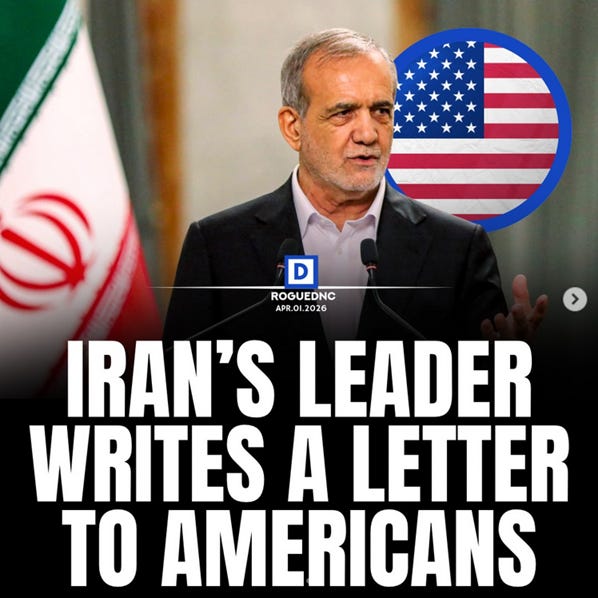
Iranian president speaks directly to the American people about US-Israeli war on Iran

Attacking Iran’s vital infrastructure directly targets the Iranian people. Beyond constituting a war crime, such actions carry consequences that extend far beyond Iran’s borders.

By Fareed Khan 
A version of this can be found on Substack.

BREAKING FROM IRAN: In a calculated diplomatic maneuver released just hours before President Donald Trump’s televised address to the American people, Iranian President Masoud Pezeshkian has issued an open letter directly to US citizens. The timing appears deliberate: an effort to get ahead of what Tehran anticipates will be a speech filled with justifications, distortions, and rationalizations for the ongoing US-led war against Iran.
Framing the conflict as one rooted in long-standing American aggression rather than any inherent Iranian threat, Pezeshkian urges Americans to look beyond what he describes as a “flood of distortions and manufactured narratives” emanating from Washington. He portrays the impending Trump address as likely to recycle familiar anti-Iranian talking points—depicting Iran as an existential danger, an aggressor, or a destabilizing force—while downplaying or ignoring the broader context of US interventions in the region that has made them and Israel the most destabilizing actors in the Middle East.

In the letter, Pezeshkian firmly denies that Iran poses any threat to the American people or harbours enmity toward them. He points out that Iran has never initiated aggression or sought expansion since the US achieved independence, positioning its actions instead as measured responses grounded in legitimate self-defence against foreign attacks. Portraying Iran as a menace, he argues, is inconsistent with both historical reality and observable facts, and stems more from America’s geopolitical and economic agenda rather than from genuine security concerns.

A central warning in the letter focuses on the human and global costs of US strikes. Pezeshkian highlights that any US or Israeli attacks on Iran’s vital infrastructure—including energy and industrial facilities—would be actions that directly target ordinary Iranian civilians. “Beyond constituting a war crime,” he states, “such actions carry consequences that extend far beyond Iran’s borders.” He questions whose interests are truly being served by prolonging the war, asking pointedly whether Trump’s “America First” agenda is genuinely guiding US policy or if other influences are at play, in a veiled reference to Israel.

By appealing straight to the American public over the heads of their government, Pezeshkian seeks to sow doubt about official US justifications, evoke shared humanity between the two peoples, and preempt any narrative that casts Iran solely as the villain. The letter blends defiance with a call for reflection, suggesting the path of confrontation is costlier and more futile than diplomacy, while reminding Americans of past US actions in Iran, such as the 1953 coup which overthrew a democratically elected government, installed Shah Mohammad Reza Pahlavi as its absolute ruler, and sowed the seeds of the 1979 Iranian Revolution, and decades of anti-American hostility by Iranians.

As Trump prepares to outline his administration’s stance on the conflict—potentially defending escalation, outlining military objectives, or framing the campaign as necessary for regional stability and American security—Pezeshkian’s message stands as a direct counter-narrative. It aims to frame the US as the escalator and aggressor, urging US citizens to scrutinize the rationales they are about to hear and consider the wider repercussions before further support solidifies behind continued hostilities.


FULL LETTER:

“To the people of the United States of America, and to all those who, amid a flood of distortions and manufactured narratives, continue to seek the truth and aspire to a better life:

Iran—by this very name, character, and identity—is one of the oldest continuous civilizations in human history. Despite its historical and geographical advantages at various times, Iran has never, in its modern history, chosen the path of aggression, expansion, colonialism, or domination. Even after enduring occupation, invasion, and sustained pressure from global powers—and despite possessing military superiority over many of its neighbors—Iran has never initiated a war. Yet it has resolutely and bravely repelled those who have attacked it.

The Iranian people harbor no enmity toward other nations, including the people of America, Europe, or neighboring countries. Even in the face of repeated foreign interventions and pressures throughout their proud history, Iranians have consistently drawn a clear distinction between governments and the peoples they govern. This is a deeply rooted principle in Iranian culture and collective consciousness—not a temporary political stance.

For this reason, portraying Iran as a threat is neither consistent with historical reality nor with present-day observable facts. Such a perception is the product of political and economic whims of the powerful—the need to manufacture an enemy in order to justify pressure, maintain military dominance, sustain the arms industry, and control strategic markets. In such an environment, if a threat does not exist, it is invented.

Within this same framework, the United States has concentrated the largest number of its forces, bases, and military capabilities around Iran—a country that, at least since the founding of the United States, has never initiated a war.

Recent American aggressions launched from these very bases have demonstrated how threatening such a military presence truly is. Naturally, no country confronted with such conditions would forgo strengthening its defensive capabilities. What Iran has done—and continues to do—is a measured response grounded in legitimate self-defense, and by no means an initiation of war or aggression.

Relations between Iran and the United States were not originally hostile, and early interactions between the Iranian and American people were not marred with hostility or tension. The turning point, however, was the 1953 coup d’état—an illegal American intervention aimed at preventing the nationalization of Iran’s own resources. That coup disrupted Iran’s democratic process, reinstated dictatorship, and sowed deep distrust among Iranians toward U.S. policies.

This distrust deepened further with America’s support for the Shah’s regime, its backing of Saddam Hussein during the imposed war of the 1980s, the imposition of the longest and most comprehensive sanctions in modern history, and ultimately, unprovoked military aggression—twice, in the midst of negotiations—against Iran.

Yet all these pressures have failed to weaken Iran. On the contrary, the country has grown stronger in many areas: literacy rates have tripled—from roughly 30% before the Islamic Revolution to over 90% today; higher education has expanded dramatically; significant advances have been achieved in modern technology; healthcare services have improved; and infrastructure has developed at a pace and scale incomparable to the past. These are measurable, observable realities that stand independent of fabricated narratives.

At the same time, the destructive and inhumane impact of sanctions, war, and aggression on the lives of the resilient Iranian people must not be underestimated. The continuation of military aggression and recent bombings profoundly affect people’s lives, attitudes, and perspectives. This reflects a fundamental human truth: when war inflicts irreparable harm on lives, homes, cities, and futures, people will not remain indifferent toward those responsible.

This raises a fundamental question: Exactly which of the American people’s interests are truly being served by this war? Was there any objective threat from Iran to justify such behaviour? Does the massacre of innocent children, the destruction of cancer-treatment pharmaceutical facilities, or boasting about bombing a country “back to the stone ages” serve any purpose other than further damaging the United States’ global standing?

Iran pursued negotiations, reached an agreement, and fulfilled all its commitments. The decision to withdraw from that agreement, escalate toward confrontation, and launch two acts of aggression in the midst of negotiations were destructive choices made by the U.S. government—choices that served the delusions of a foreign aggressor.

Attacking Iran’s vital infrastructure—including energy and industrial facilities—directly targets the Iranian people. Beyond constituting a war crime, such actions carry consequences that extend far beyond Iran’s borders. They generate instability, increase human and economic costs, and perpetuate cycles of tension, planting seeds of resentment that will endure for years. This is not a demonstration of strength; it is a sign of strategic bewilderment and an inability to achieve a sustainable solution.

Is it not also the case that America has entered this aggression as a proxy for Israel, influenced and manipulated by that regime? Is it not true that Israel, by manufacturing an Iranian threat, seeks to divert global attention away from its crimes toward the Palestinians? Is it not evident that Israel now aims to fight Iran to the last American soldier and the last American taxpayer dollar—shifting the burden of its delusions onto Iran, the region, and the United States itself in pursuit of illegitimate interests?

Is “America First” truly among the priorities of the U.S. government today?

I invite you to look beyond the machinery of misinformation—an integral part of this aggression—and instead speak with those who have visited Iran. Observe the many accomplished Iranian immigrants—educated in Iran—who now teach and conduct research at the world’s most prestigious universities, or contribute to the most advanced technology firms in the West. Do these realities align with the distortions you are being told about Iran and its people?

Today, the world stands at a crossroads. Continuing along the path of confrontation is more costly and futile than ever before. The choice between confrontation and engagement is both real and consequential; its outcome will shape the future for generations to come. Throughout its millennia of proud history, Iran has outlasted many aggressors. All that remains of them are tarnished names in history, while Iran endures—resilient, dignified, and proud.”


© 2026 The View From Here. © 2025 Fareed Khan. All Rights Reserved.

2026-03-16

OP-ED -- Refusal to condemn US-Israeli illegal war on Iran shows the hypocrisy of Canada’s ‘rules-based’ PM

Mark Carney’s powerful words at Davos now ring hollow as he fails to stand up to the US and Israel after their illegal attack on Iran.
 
This has previously been published on Rabble.ca.
A version of this can be found on Substack.

In the final judgment of the International Military Tribunal at Nuremberg in 1946, the Allied powers delivered a verdict that still echoes as the bedrock of modern international law: “To initiate a war of aggression … is not only an international crime; it is the supreme international crime differing only from other war crimes in that it contains within itself the accumulated evil of the whole.”

 
That supreme international crime is being committed right now, in real time, by the United States and Israel. On February 28, these two rogue powers launched an unprovoked, unjustified assault on the sovereign territory of Iran. As missiles and bombs rained down one of the targets hit on the first day was a girls’ primary school in Minab, slaughtering at least 165 innocent schoolgirls. Iran’s Supreme Leader Ayatollah Ali Khamenei was also assassinated along with a number of senior leadership figures. Civilian infrastructure, including oil depots, have been pulverized, more than 1,300 have been killed so far and more than 17,000 have been injured. This was not an act of self-defence, but rather naked aggression—the exact crime the Nuremberg Tribunal branded as a supreme evil. 
 
The history of the current Iranian regime is not a pretty one. Yes, it has been brutal, it crushes protesters, oppresses women, jails and tortures dissidents. That deserves unequivocal condemnation. But Iran’s brutality at home does not grant a license to other nations to bomb a sovereign state into submission. The rule of law is not a buffet. You don’t get to pick and choose when it applies based on whose regime you dislike. 
 
Yet that is precisely what Mark Carney is doing. Canada’s prime minister has refused—point-blank—to call this aggression by its proper name. He has issued tepid calls for “restraint” while conspicuously refusing to condemn the two nations that started this inferno. He even expressed support for the strikes, framing them as necessary to stop Iran from acquiring nuclear weapons. The reality, confirmed by anonymous US intelligence sources, the International Atomic Energy Association, and independent experts, is that Iran was nowhere near a functional nuclear weapon. No imminent threat existed. Diplomacy was progressing. Talks were constructive. Then came the missiles.  
 
Only weeks before the attack, Carney stood at the World Economic Forum in Davos and delivered a lofty speech about the need for “smaller nations” to band together to uphold international law, sovereignty, and the rules-based order. He spoke passionately about middle powers defending territorial integrity and rejecting the law of the jungle. So what was the point of that speech if he now endorses the very thing he criticized? Was it empty rhetoric designed to impress Davos elites while he quietly supported the very violations he claimed to oppose in January?  
 
If Canada truly believes in international law, why the cowardly silence when the world’s most powerful actors torch it? The question demands an answer. Is Carney only interested in upholding international law when it serves Canada and its allies? Or is he committed to the territorial sovereignty of all nations—ally and adversary alike?
 
Carney’s initial response to this new war screams selective enforcement. Canada was among the loudest voices condemning Russia’s invasion of Ukraine as a flagrant violation of the UN Charter. Sanctions were imposed amid speeches filled with outrage. “Rules-based order” became a mantra. Yet when the United States and Israel launch an illegal war of aggression against Iran—bombing civilian sites, assassinating leaders, and igniting a regional conflagration—Canada offers support “with regret” at best, and deflection at worst. No demands for accountability, just platitudes about diplomacy while the innocent die. 
 
International experts are calling out this grotesque double standard. UN Special Rapporteur Ben Saul has stated bluntly that the US-Israeli strikes “appear to breach the UN Charter’s prohibition on aggression” and lack any valid legal justification.  
 
Yusra Suedi, assistant professor of international law at the University of Manchester, warns that the attacks amount to a crime of aggression and expose the “unravelling fragility” of international law—precisely the same fragility the West highlighted when Russia invaded Ukraine but now conveniently overlooks for its own allies.  
 
Rebecca Ingber, a professor at Cardozo School of Law at Yeshiva University said, “The use of wanton military force has contributed to a sense of impunity for powerful states and has degraded the international law system.”   
 
The Global Centre for the Responsibility to Protect has documented the pattern—a swift, unified condemnation of Russia’s actions in Ukraine contrasted with excuses, silence, or outright support for US-Israeli aggression against Iran, Gaza, Lebanon, and beyond.  
 
The greatest beneficiaries of Washington’s contempt for the UN Charter are the very actors the West claims to oppose—Russia, now emboldened in Ukraine, and China, watching for its moment in Taiwan. The message to the world is clear—international law is a weapon to be wielded against adversaries, never against ourselves. 
 
Instead of demonstrating principled leadership Carney has shown rank hypocrisy that shames Canada’s international reputation. Not surprising given his government’s refusal to recognize Israel’s actions in Gaza as genocide, despite the overwhelming evidence and the explicit findings of Amnesty International, Human Rights Watch, B’Tselem, Médecins Sans Frontières the International Association of Genocide Scholars, the UN and numerous other respected international organizations. 
 
Instead, Canada continues to ally itself with and politically shield nations committing the gravest of international crimes while Iran burns and its people suffer.By backing—or at minimum refusing to condemn—this war of aggression, Carney has aligned Canada with the very forces that he criticized in Davos, ones that ignore the rule of law, inflict chaos and suffering, while their victims are left to bury the corpses. We were supposed to have left that era behind after 1945. Yet here we are returning to the law of the jungle. 
 
The strikes were launched while negotiations over Iran’s nuclear program were reportedly advancing. The 2015 nuclear deal with Iran—negotiated under Barack Obama—was working until Trump tore it up at Netanyahu’s behest. Carney knows this, yet he calls for “restraint” now that the genie is out of the bottle. He condemns Iran’s retaliation but refuses to name the original aggressors. Why? 
 
Because consistency would require Canada to stand on principle against powerful allies. Because admitting the attack on Iran violates the UN Charter would expose the hypocrisy. Because Carney’s vaunted Davos vision is performative theatre not meant to apply to the crimes of allies. 
 
Canada cannot claim moral authority when our prime minister shrinks from stating the obvious—the US-Israeli assault on Iran is illegal, dangerous, and a direct breach of the UN Charter and the territorial sovereignty of a member state. Carney’s refusal to condemn it reveals exactly where his true commitments lie—to power and alliance above principle. 
 
The world is watching. Smaller nations—the very ones Carney claimed to champion in Davos—are taking notes. If Canada will not defend the rules when it matters most, against the most powerful violators, then Carney’s words were worthless. International law either applies to everyone or it applies to no one. The shame belongs to him—and to every Canadian who still believes their government stands for something more than selective hypocrisy. 
 
The path forward is anarchy unless leaders like Carney find the courage to speak truth to power—starting with naming the supreme crime for what it is. Until then, his Davos speech will stand as a monument to empty rhetoric and moral bankruptcy. 

© The View From Here.  © Fareed Khan.  All Rights Reserved.

2026-03-15

Global nuclear non-proliferation dealt a fatal blow with US-Israeli attack on Iran

The US-Israel military campaign against Iran is not just another regional war. It is a profound setback to the slow, fragile progress toward a world with fewer nuclear weapons.
 
By Fareed Khan 
A version of this can be found on Substack.
 
On February 28th the United States and Israel launched a coordinated and unprovoked military assault on Iran. This unprecedented aggression targeted Iran's nuclear facilities, ballistic missile sites, military command structures, as well as targets in Iran's major urban centres.  The strikes were intended to destroy what remained of Tehran's nuclear program after a previous round of strikes in June 2025, which US President Donald Trump claimed at the time "completely and totally obliterated" Iran's key nuclear enrichment facilities.


He framed the operation this week as necessary to prevent Iran from acquiring nuclear weapons, but provided no proof that Iran was anywhere near completing a nuclear warhead.  However, the repercussions of the attack are far more damaging. By attacking a non-nuclear state amid ongoing diplomatic talks, the US and Israel have not only done serious damage to the Iranian regime but also dealt a severe blow to global nuclear non-proliferation efforts. This act of aggression sends a chilling message to smaller nations that the only reliable deterrence against powerful bullies like the US and Israel is to acquire nuclear weapons of your own.

The assault on Iran underscores a harsh truth about international power dynamics. For decades, the Nuclear Non-Proliferation Treaty (NPT) has been the main tool used by the international community to prevent the spread of nuclear weapons, with nuclear-armed states like the US promising security in exchange for others' restraint. But the attack on Iran flips this logic on its head. Iran, a signatory to the NPT, had been negotiating limits on its nuclear activities when the bombs fell.  Diplomacy was abandoned in favor of force, proving that even compliance offers no protection from pre-emptive strikes. As experts have noted, this incentivizes proliferation, with other nations with the capability now looking to develop nuclear programs as a deterrent before they themselves are attacked and their governments overthrown. Smaller nations, witnessing Iran's fate, will conclude that nuclear weapons are essential for survival against hegemonic powers like the US, China and Russia.

Consider Ukraine, a stark example of the perils of denuclearization. In 1994, Ukraine inherited the world's third-largest nuclear arsenal from the Soviet Union but relinquished it under the Budapest Memorandum, receiving security assurances from Russia, the US, and the UK. Russia violated those assurances in 2014 by annexing Crimea and again in 2022 with a full-scale invasion. Ukrainian officials have lamented the decision to denuclearize, with one MP stating, "We gave up nuclear weapons because of this agreement. Now, there's a strong sentiment in Ukraine that we made a big mistake." Had Ukraine retained its arsenal, Russia might never have considered invasion, deterred by the threat of nuclear escalation. Instead, denuclearization left Ukraine vulnerable, reinforcing the lesson that lack of a nuclear deterrent invites aggression.

Libya's experience echoes this tragedy. In 2003, Muammar Gaddafi abandoned his weapons of mass destruction (WMD) program, including nascent nuclear efforts, in exchange for normalized relations with the West and a security guarantee. Eight years later, in 2011, NATO intervened in Libya's civil war under a UN mandate to protect civilians, but the operation expanded into regime change, leading to Gaddafi's overthrow and death. The intervention, led by the US, UK, and France, demonstrated that giving up WMDs offers no lasting security. As one analysis put it, this set a precedent for authoritarian regimes--nuclear weapons deter foreign intervention. North Korea's Kim Jong-un has cited Libya as a reason for his nation developing its nuclear arsenal, viewing it as protection against a possible attack by the US.

North Korea stands as the counterexample, proving the deterrent value of nuclear weapons. Facing US threats of regime change since the Korean War, Pyongyang pursued nukes relentlessly, conducting its first test in 2006. Today, with an estimated 50 warheads and advanced missiles, North Korea has effectively shielded itself from invasion. Analysts argue that its arsenal deters US aggression, allowing provocations like missile tests without fear of full-scale war. The US-Israel attack on Iran only bolsters the view that non-nuclear states are prey, while those with nuclear weapons and the means to deliver them are predators.

Israel's role in this hypocrisy cannot be ignored. It possesses an undeclared nuclear arsenal of an estimated 90 to possibly more than 200 warheads, and refuses to sign the NPT or allow IAEA inspectors into its nuclear facilities. Its policy of "nuclear opacity" undermines global non-proliferation efforts, as it demanded that Iran disarm while maintaining its own nuclear monopoly in the Middle East. Since the 1980s, Israel has threatened Iran, viewing its support for Palestinian rights as a threat, with Prime Minister Benjamin Netanyahu repeatedly claiming that Iran was weeks away from a nuclear bomb—assertions dating back to the 1990s that have never materialized. He made similar false claims about Iraq's WMD in 2002 and Libya, both strong supporters of Palestinians. Israel's history of aggression—bombing or invading every neighbor since 1948, including recent strikes on Yemen, Qatar, and now Iran—fuels regional instability. This belligerence, backed by undeclared nukes, drives others to seek deterrence, thereby undermining non-proliferation efforts.

The fallout from the Iran attacks last summer is already evident. In September 2025, Saudi Arabia signed a mutual defense pact with Pakistan, placing the kingdom under Pakistan's nuclear umbrella. Officials hinted that "all military means," including nukes, are encompassed. This deal, a response to perceived threats from Israel after the June 2025 attacks on Iran, shows how attacks on non-nuclear states by those with nuclear arms accelerates proliferation. Saudi Arabia, fearing similar strikes, has secured nuclear protection without developing its own arsenal, bypassing the NPT. Now, given the most recent aggression by the US and Israel, more nations may follow, eroding the global regime.

Why does the West accept this double standard? Canada, for instance, opposes rogue nuclear states but overlooks Israel's illegal arsenal, and does little beyond PR statements and political platitudes in response to repeated military aggression by the Zionist state against neighbouring nations. The US, the only nation to use nuclear weapons in war, lectures others while enabling Israel's opacity.

Russia and China acquired nukes after World War 2 fearing US dominance. The UK and France followed suit due to Cold War threats from the Soviet Union. North Korea's program stems from fears of a US invasion. The only way to understand this mentality on a personal levels is to consider if a neighbor threatens you with guns and authorities fail to protect, then you would most likely arm yourself.  Under the seeming lawlessness that the world is witnessing with the attack on Iran it wouldn't be surprising if nations behaved similarly.

The attack on Iran will accelerate this cycle. Experts warn, it incentivizes proliferation and makes adversaries hesitant to participate in good faith diplomacy with the United States lest they experience the same fate as the Iranians. Iran, battered but surviving, may redouble secret efforts, and others, like Saudi Arabia, will seek alliances with nuclear states. Weaker nations with resources will prioritize nukes for self-defence, with Iran being a prime example of what could happen to a nation that does not bow to stronger military powers.

To salvage the global non-proliferation regime, we must confront its deepest underlying cause--the stark power imbalance between nuclear-armed states and those without them. A genuine commitment to nuclear disarmament requires universal action—dismantling all arsenals, including Israel's undeclared one—and bringing an end to hegemonic aggression that fuels insecurity worldwide.

The NPT rests on three inseparable pillars: non-proliferation, disarmament, and the peaceful use of nuclear energy. True adherence demands that nuclear-weapon states fulfill their Article VI obligations by leading through example, rather than perpetuating a system where they retain monopoly power while demanding restraint from others.  As long as the nuclear powers modernize and expand their arsenals instead of disarming, non-nuclear states will view nuclear weapons as the ultimate equalizer—the only credible guarantee of survival in a world where might dictates right.

The ongoing US-Israel military campaign against Iran is far more than another regional war. It is a profound setback to the slow, fragile progress toward a safer world—one with fewer nuclear weapons and stronger diplomatic norms. By choosing pre-emptive force over negotiation at a moment when talks had shown promise, this assault risks shattering the NPT's credibility entirely, accelerating proliferation pressures, and closing the door on the very diplomacy needed to prevent a cascade of new nuclear states.

The path forward is clear.  Nuclear powers must finally honor their disarmament commitments, or the treaty they claim to defend will collapse under the weight of their own hypocrisy. Only then can we hope to build genuine security—not through endless cycles of dominance and retaliation, but through shared vulnerability and mutual restraint. The alternative is a more dangerous world for everyone.


© The View From Here.  © Fareed Khan.  All Rights Reserved.

2026-03-11

SMART PEOPLE DON’T

By Fareed Khan 
A version of this can be found on Substack.

Smart people don’t believe that
the United States rides in to save the day,
waving flags of freedom while bombs fall like rain,
turning cities to rubble in the name of democracy.

Smart people don’t swallow tales
of soldiers dying for noble causes, when the orders
come from boardrooms and think tanks, and the dead
 and injured are just numbers on someone’s ledger.

Smart people don’t imagine women’s rights blooming
from drone strikes and invasions, when the perpetrators
arm tyrants who oppress their people, and the truth
vanishes under the roar of precision-guided lies.

Smart people don’t expect flowers and parades
after governments are toppled, when chaos births
power vacuums that breed new monsters, all while
oil contracts are quietly signed without fanfare.


Smart people don’t trust the official story
spun by the same mouths that sold previous wars
with doctored intelligence about WMDs, then shrugged
when the graves of the innocent were being dug.

Smart people don’t see cartoon heroes
in camouflage and stars-and-stripes, pitting flawless
“good” against cartoonish “evil”, while the real
ledger dripping in blood, records huge profits.

Smart people don’t pretend that
Washington’s hands are cleaner than Tehran’s,
when both crush dissent and both count bodies,
yet only one controls the global headlines.

Smart people don’t gorge on atrocity porn
served up fresh each morning, without asking
who benefits from the latest horror, or why stories
about the other side’s victims and orphans are never told.


Smart people don’t accept “self-defence” 
as a legitimate excuse for waging war, when the
battlefield is thirteen thousand kilometres away, and
the threat is a lie manufactured in briefing rooms.

Smart people don’t buy compassion
from a man-child who destroys democracy at home,
while preaching freedom to distant populations, as if
the cruelty he inflicts abroad is invisible to his own people.

Smart people don’t march to war
because ancient scripture says they should, or because
one patch of desert is part of one people’s prophecy, and
those on that land are bled for another people’s faith.

Smart people don’t weigh
an Iranian life less than an American one,
as if geography and complexion decides whose blood 
has value, and whose screams of terror deserve only silence.


Smart people don’t look at a military machine
and see a global charity, when its legacy is
annihilation, mass graves, and repeated atrocities,
and its mission is domination dressed as deliverance.

Smart people don’t expect democracy to grow from
bombing foreign lands, when history shows that
occupation breeds resentment and revenge, and 
puppet leaders show their strings being pulled by the US.

Smart people don’t cheer a war that fattens the
wallets of defence contractors and shields a genocidal ally,
while the people it claims to be saving pay a price 
in blood, and the rest of us are told to look away.

Smart people don’t mistake a fading fascist empire’s mask
for a saviour’s face, when the arc of its history bends
toward control, and it only values freedom in order
to pursue its own imperial agenda.


© 2026 The View From Here. © 2026 Fareed Khan. All Rights Reserved.