Showing posts with label American imperialism. Show all posts

2026-08-09

Evil in our time: The West is living the “banality of evil” (Part 2/2)

Violent oppression produces resistance. Brutality provokes retaliation. Violence creates more violence—not because the oppressed desire it, but because it is the only remaining path to survival when all peaceful avenues are blocked.

By Fareed Khan
A version of this article can be found on Substack.

In her writings about the “banality of evil” Jewish philosopher Hannah Arendt warned that when evil becomes normalized, when it is rendered ordinary, carried out not by fanatics or monsters, but by professionals, government functionaries, and ordinary people, who see themselves as moral, and neutral executors of policy, that is when we have reached the peak of evil in a society. 

After almost three years of Israel committing genocide in Gaza, we must accept that this is what has happened in Israel, as well as in the Western nations that continue to support it and enable its genocidal crimes.

The cruelty visible in Israel’s actions in Gaza is not confined to the state or its military. It is reflected in the attitudes that have taken hold within significant parts of Israeli society. When a Haaretz poll in June 2025 reported that 47% of Israeli Jews supported exterminating all Palestinians in Gaza “down to the last child,” that is the normalization of evil. When 82% supported the complete ethnic cleansing of Palestinians from Gaza, that too is the normalization of evil. And when 56% supported expelling all Palestinians from territories under Israeli control, it reflected a society in which dehumanization of Palestinians has become routine. Each of these positions constitutes a violation of international law, yet they are expressed as ordinary political preferences.


This is what happens when cruelty becomes embedded in daily life. It is normalized, rationalized, and stripped of moral consequence. In such an environment, moral responsibility does not merely weaken — it dissolves.

Whatever one thinks about the Hamas attack on October 7, 2023 the reality that followed exposed a deeper structural evil—not only in Israeli society but also in the West—where Palestinian dehumanization is accepted, and where Israel’s genocide has been enabled almost entirely by Western power. The United States under President Joe Biden and Donald Trump, the United Kingdom under Rishi Sunak and Keir Starmer, Germany under Olaf Scholz and Friedrich Merz, France under Emmanuel Macron, and Canada under Justin Trudeau and Mark Carney all continued supplying weapons, ammunition, and military components to Israel throughout the most intense periods of Israel’s genocide— arming a state as it carried out what major human rights organizations, along with Holocaust and genocide scholars have described as the crime of genocide.

This is not a case of passive complicity. It is active participation in the crime of crimes.

The scale of destruction is staggering. According to a study by Ben Gurion University professor Yakov Garb, published through Harvard Dataverse, more than 377,000 Palestinians had been killed in Gaza by May 2025. And in July 2025, Australian academics Richard Hil and Gideon Polya published a study in Arena concluding that Israel had killed more than 680,000 Palestinians in Gaza, directly and indirectly.

These numbers are not abstract. They represent human beings—families, children, elders, entire communities—obliterated.

Israel, supported by Western governments, tried to lable their actions as “self‑defence.”  But self‑defence does not typically include starving a besieged population, bombing hospitals, destroying universities, mosques and churches, killing journalists, and sustaining mass killing over extended periods. The repeated use of the term is an attempt to prevent moral scrutiny—language functioning as a shield for inhumane policy.

Consider what Western support has meant in practice. Western governments supplied the weapons used to level neighbourhoods and destroy civilian life. They offered diplomatic cover that neutralized international accountability. They obstructed ceasefire efforts. They ignored rulings and warnings when those rulings threatened the continued flow of arms or the maintenance of strategic alliances. They treated genocide allegations raised by scholars and human rights organizations as politically inconvenient noise.

Where evil is concerned silence is not neutral. Silence is a form of governance and action. When Western institutions refused to name what is happening in Gaza as genocide even when credible experts and major human rights organizations did—the West communicated to Israel that it would tolerate mass murder, mass destruction, minimize it and eventually normalize it—the result is that violence on this scale becomes easier the next time, not harder.

Evil thrives on normalization. Once cruelty becomes routine—embedded in procedures, justified through euphemisms, and stripped of historical context—it clears a path for even greater evils, including war.

The Nuremberg Tribunal understood this with chilling clarity. In its final judgment, it declared: “War is essentially an evil thing. Its consequences are not confined to the belligerent states alone, but affect the whole world... A war of aggression is the supreme international crime differing only from other war crimes in that it contains within itself the accumulated evil of the whole.”

War is horrific. Yet Western elites have increasingly treated war not as a moral failure but as a policy instrument—something to be managed, rationalized, and deployed when convenient. They speak of “precision,” “deterrence,” and “security imperatives,” as if technical language can erase the bodies floating in rivers of blood beneath it. This rhetorical distancing matters as it allows decision-makers, commentators, and bureaucrats to observe suffering from a safe distance while pretending that sanitized terminology absolves them of responsibility.

In this way, Arendt’s warning about the “banality of evil” becomes unmistakably relevant. When violence is normalized through language and procedure, when moral judgment is replaced by administrative habit, evil does not merely persist—it expands. And war becomes its most devastating expression.

Whether it’s in war or like what Israel has done in its decades-long occupation of the Palestinian people, oppressed people who resist are often condemned as “terrorists” or “extremists” without acknowledging what preceded them: occupation, dispossession, blockade, and systematic dehumanization. Meanwhile, the violence of those with state power is excused as strategic necessity.

Violence has a history. Oppression produces resistance. Brutality provokes retaliation. Violence generates more violence—not because the oppressed desire it, but because it becomes the only remaining path to survival when every peaceful avenue has been blocked and when their oppressor uses every legal, political, and military tool available to prevent justice. People cling to nonviolence as long as they can, but when survival itself is threatened, nonviolence becomes impossible as a practical matter. To ignore this context is not moral seriousness; it is moral evasion.

To confront evil properly, one must look at its genealogy. In the case of the Palestinian cause there is a history of betrayal stretching back over a century—British duplicity during World War 1, the Balfour Declaration, the suppression of uprisings, immigration policies the mass migration of Jews into Palestine, the UN partition granting Jews a majority of the land of historic Palestine despite being a minority of the population, and the Nakba—the ethnic cleansing of more than 750,000 Palestinians.

After that came decades of apartheid-like practices, military occupation, land theft, settlement expansion, and systemic dehumanization. For generations, Palestinians have been treated not as human beings with rights but as demographic threats to be contained, controlled, displaced and ultimately exterminated. For people living under siege—whose homes are taken, whose movements are restricted, and whose lives are governed by violence—the ethical appeal to “use peaceful means” is not a legitimate moral argument. It is a refusal to acknowledge reality.

The Gaza genocide has shattered the illusion of Western moral superiority. It has exposed human rights discourse as selective—racialized, politicized, and contingent on geopolitical interests. It has revealed that Western empathy is not universal; it is filtered through alliances, strategic calculations, and narratives designed to protect power rather than people.

What has emerged is not merely hypocrisy but something more corrosive: a profound moral incapacity within Western institutions to see Palestinians as fully human. Their suffering is suppressed by major media outlets, minimized in elite discourse, and reframed or ignored by political leaders. Their voices are sidelined in academia and public life. Their persecution is met not with outrage by the elites but with diplomatic cover, continued arms shipments, and bureaucratic indifference.

This is why evil cannot be understood solely as the actions of one army or one government. It resides in the systems that enable those actions while shielding their architects from accountability. Genocide is never the work of a single individual. Hitler did not carry out the Holocaust alone; he set the direction, but thousands of bureaucrats, officers, industrialists, propagandists, and collaborators operated the machinery of death. Likewise, the Gaza genocide is not solely the responsibility of Israel’s prime minister Benjamin Netanyahu, his cabinet, his advisers, or his military commanders—though they bear immense culpability. It is also the responsibility of the Western leaders who armed them, the diplomats who protected them, the media figures who sanitized their actions, and the bureaucrats who processed the shipments, approved the transfers, and maintained the infrastructure of destruction.

Evil becomes most powerful when it is distributed across institutions—when it is normalized, rationalized, and made routine. Gaza has revealed that this machinery exists throughout Western societies and certainly in Israel and the US.  It is embedded in the political, military, and bureaucratic systems that make atrocity possible and then shield those responsible from accountability.

It must be noted that this pattern is not unique to the West. The same institutional logic underlies Russia’s unprovoked war on Ukraine and the U.S.–Israeli military operations against Iran. These are not the actions of lone individuals but of entire systems of power, ideology, and obedience. Evil on this scale requires thousands of hands—politicians, generals, analysts, media figures, and administrators—each performing their role, each contributing to a larger architecture of violence.

And when systems of power operate this way, oppressed peoples eventually reach a point where surviving on their knees is worse than resisting and possibly dying on their feet. After decades of brutal oppression Palestinians reached that point long ago. The West—through its weapons, its propaganda, its indifference, and its diplomatic obstruction—has ensured that they had no path toward safety and survival other than through violent resistance. When institutions normalize injustice, armed resistance becomes not a choice but a last remaining means of survival.

Evil exists in Moscow and Beijing, yes. It exists wherever power dehumanizes the vulnerable. But it also exists in Washington, London, Paris, Berlin, Ottawa, Tel Aviv—and wherever Western institutions decide that some lives are less deserving of protection, less deserving of rights, and less deserving of international enforcement of the law. Evil is not confined to adversaries; it flourishes wherever systems of power treat human beings as expendable.

Until the West confronts its own role in perpetuating global violence—until it dismantles the incentives, narratives, and institutional mechanisms that make atrocity easy—it cannot claim the moral high ground. Where evil exists, it must be named and called out, without exception or euphemism. And where it is in recent decades—too often—it has been Western. Refusing to confront this reality is not neutrality, it is complicity. A society that will not face the evil it enables inevitably slides back toward barbarism and anarchy, because unacknowledged evil does not disappear—it grows.

© 2026 The View From Here. © 2026 Fareed Khan. All Rights Reserved.


2026-08-08

Evil in our time: The West is living the “banality of evil” (Part 1/2)

Evil poses the greatest danger when it is rendered ordinary, when ordinary people see themselves as just living normally and doing jobs they were given that promote evil or inflict evil. 

By Fareed Khan
A version of this article can be found on Substack.

Jewish philosopher Hannah Arendt developed the idea of the “banality of evil” while observing the war-crimes trial of Adolf Eichmann, one of the central administrators of the Holocaust. Her insight—that immense cruelty can be carried out by ordinary people performing routine tasks—has shaped how many of us understand evil today. From her writings, from the lessons of history, and from our own experiences, we have come to accept that evil is not abstract. It exists, and we recognize it long before we can explain it.


Most of us sensed this even as children. We learned about good and evil through stories—superhero cartoons, comic books, films. There was always a hero protecting the innocent and a villain bent on destruction, indifferent to the suffering they caused. Perhaps that is why hundreds of millions around the world have flocked to theatres to watch superhero films since the genre exploded in popularity in the early 2000s. People want to see good triumph over evil, because in the real world that victory feels increasingly rare.

The collapse of childhood morality

As we grew older, the simplicity of childhood morality gave way to a harsher truth. Evil was not an abstraction. It was not confined to fictional villains or imaginary worlds. It was a real force—systemic, organized, and embedded in institutions, policies, and individual acts that inflict pain and suffering on innocent people. Like many raised in the West, we were taught a comforting moral vocabulary, that democracy triumphs over tyranny, rule of law over brutality, human rights over barbarism. But the lessons of history tell a very different story.

History catalogued humanity’s depravity and the catastrophic capacity of states and individuals to degrade, dispossess, exterminate, with acts that are inherently evil. We learned about the genocide of Indigenous peoples across the Americas, Africa, Asia, Australia and Oceania, the evils of European colonial empires, the two world wars, the Holocaust, and the many other atrocities of the previous two centuries. We were taught how Cold War geopolitics led both blocs to support ruthless dictators, how propaganda laundered cruelty into necessity, and how the language of morality became political camouflage—allowing governments and leaders to commit acts that, at the level of individual conscience, most of us would find abhorrent and unacceptable.

The myth of Western innocence

In Canada, these lessons were never distant abstractions. We learned about the treatment of Indigenous peoples by colonial authorities and later by the Canadian state—how government policies, disease, displacement, and deliberate neglect produced a demographic collapse so severe that roughly 95% of Indigenous people died from the time of first contact with Europeans to the end of the 19th century. We learned how these policies were not accidental or peripheral, but central to the project of building Canada.  They included land seizure, forced starvation, residential schools, the pass system, and the suppression of Indigenous governance, and were all instruments of a state determined to eliminate Indigenous presence as a political and cultural force.

And the brutality did not end with the 19th century. Explicitly genocidal policies—child removal, cultural destruction, coerced assimilation, and systemic land dispossession—remained in place well into the late 20th century, with some saying they continue today. The history we inherited made clear that evil was not confined to foreign regimes or distant eras. It was woven into the institutions, laws, and administrative practices that shaped Canada, and it operated within living memory. This country’s national story is often told as one of peace, order, and good government, but the record shows a state willing to inflict organized suffering on a massive scale when Indigenous lives stood in the way of its political goals.

Despite this history most of us likely assumed—naively—that Western societies contained less evil than their rivals. These were the nations that defeated Hitler and ended World War 2, championed civil liberties, enshrined human rights, and built institutions, like the International Court of Justice, dedicated to accountability (at least on paper). We came to believe that the West was less compromised, less willing to inflict mass suffering as policy. We believed its leaders lived by a higher morality and were constrained by law, ethics, and democratic norms.

We were very wrong.

How Western institutions normalize cruelty

In recent years, many in the West have begun to understand that evil is not something that only happens “over there.” It can take root within Western political classes, media ecosystems, academic institutions, and corporate boardrooms. We have learned—sometimes gradually, sometimes through shocking events—that these institutions seek to profit from aggression and injustice, both politically and economically. Whether we want to accept it or not evil can manifest itself in our society among elites who decide what counts as truth, whose suffering is acknowledged, and what forms of violence can be justified or ignored. And once embedded within these structures, once normalized and reinforced by power, it becomes remarkably resilient.

What changed things for many was a single event—the way Western political, media, and corporate elites responded to the October 7, 2023 Hamas attack on Israel—and the uncritical support they offered for the Israeli campaign of retribution that followed in Gaza. Rage and grief after the attack were expected, even without acknowledging the context in which it occurred—decades of oppression and mass killing of Palestinians, and the Israeli blockade and siege imposed on Gaza since 2007 that had turned the territory into the world’s largest concentration camp.

What was not expected was the speed and certainty with which Western political and media elites transformed one terror attack into a sweeping license for Israel to wage a campaign of genocide against Palestinians. The world witnessed not simply support for Israel’s right to defend itself, but an almost reflexive embrace of a war of vengeance—a refusal to de-escalate, and a demand that everyone accept the fiction that the Israel-Palestine “conflict” began on October 7th, as if decades of Israeli occupation, dispossession, and brutality toward Palestinians could be erased without consequence.

Western framing—and the deliberate elimination of history and context—did real work. As it shut down moral inquiry. By stripping away the historical conditions that preceded the Hamas attack and erasing the political reality in which Palestinian suffering has been sustained for generations, Western leaders and media outlets created a narrative in which only one side’s pain mattered. This framing implied that Western audiences need not consider proportionality, civilian harm, international law, or the ethical distinction between legitimate self-defence and collective punishment. When history can be dismissed so casually and so completely, almost any atrocity in the present becomes permissible.

Bureaucratic violence and the banality of atrocity

This instinct—violent aggression as the default moral position when Western interests or alliances are implicated—is not new. A clear look at the post‑9/11 era shows a consistent pattern, one where Western powers, especially the United States, have been responsible for some of the worst violence committed globally in the last quarter century. The “War on Terror” did not merely fight terrorism, it built a global war machine. Invasions, occupations, drone assassination campaigns, proxy wars, and sanctions regimes devastated entire societies. The stated rationales were variations of the same idea—catastrophic harm to innocent people is justified when done in the name of security, stability, and self‑defence.

The Brown University Costs of War project estimates that post‑9/11 wars have killed more than 4.5 million people, directly and indirectly—more than 90% of them Muslim. This is not an accident of geography. It is the outcome of deliberate decisions, where bombers and fighter jets are dispatched, where troops occupy civilian populations, where sanctions choke societies, where proxies are funded, and where legal constraints on government are treated as obstacles rather than safeguards.

The war in Afghanistan, launched under the justification of hunting Al-Qaeda and Osama bin Laden, evolved into a two-decade-long occupation that ultimately killed up to 360,000 civilians. The war in Iraq—sold to the world through the lie of weapons of mass destruction—became a destabilizing catastrophe where an estimated 600,000 people were killed according to the British medical journal The Lancet. Libya, Yemen, Syria, Pakistan, Somalia, and other countries were pulled into the orbit of Western coercion through the language of counterterrorism and national security. American drone strikes killed thousands of innocent civilians with bureaucratic impunity, and US torture sites proliferated across the globe. International law was not shattered in one dramatic moment, but eroded through a steady stream of exceptions, reinterpretations, and executive decisions—the proverbial death by a thousand cuts.

What stands out is not only the brutality but the moral gymnastics utilized to rationalize what can only be called acts of depravity. The violence was framed as defensive rather than predatory—an effort to protect the innocent rather than an attempt to impose geopolitical order through devastation. But if the West can call mass destruction, the destruction of entire societies, and mass murder “self‑defence” often enough, then self‑defence becomes a loophole with no ethical limits.

Arendt’s insight into the banality of evil has become disturbingly relevant in our time. What stands out in the post-9/11 era is not only the scale of violence, but the way Western governments, institutions and leaders normalized it through bureaucratic language, administrative habit, and moral disengagement. Evil did not announce itself with grand declarations. It seeped into policy recommendations, security memos, public speeches, and the quiet decisions of officials who believed they were simply doing their jobs in trying to defend “Western values.”

The wars in Afghanistan and Iraq, the American drone assassination campaigns across the Middle East and Africa, and the network of torture sites that spread across the globe were all justified through technical vocabulary—“precision strikes,” “enhanced interrogation,” “collateral damage,” “security imperatives.” These terms sanitized brutality, turning mass death into a matter of procedure. The machinery of state violence became so routine that killing innocent civilians, destroying entire societies, and shredding international law were treated as administrative necessities rather than the moral catastrophes they were.

This is precisely what Arendt warned about.  Evil poses the greatest danger when it is rendered ordinary, when acts of evil are carried out not by fanatics or monsters, but by professionals, government functionaries, and ordinary people who see themselves as moral individuals just doing the job they were given. In this situation cruelty becomes a normal part of day to day tasks. Atrocity becomes a line item, and moral responsibility dissolves into the anonymity of institutional process where people are “just following orders.”

This is the true horror of the banality of evil. Not that monstrous acts are committed by monstrous people, but that they are committed calmly, without guilt and with little afterthought by people who see themselves as having a moral compass—the way an Israeli sniper shoots a Palestinian child in the head and then celebrates with his comrades over a meal afterwards at a job well done.  And unless we confront that fact directly—the normalization of evil—we risk living in a world where atrocity is not the exception, but the norm. 

© 2026 The View From Here. © 2026 Fareed Khan. All Rights Reserved.

2026-04-01

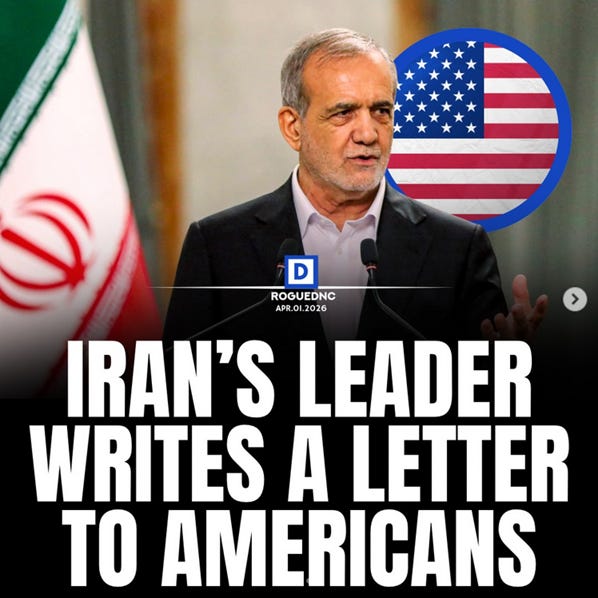
Iranian president speaks directly to the American people about US-Israeli war on Iran

Attacking Iran’s vital infrastructure directly targets the Iranian people. Beyond constituting a war crime, such actions carry consequences that extend far beyond Iran’s borders.

By Fareed Khan 
A version of this can be found on Substack.

BREAKING FROM IRAN: In a calculated diplomatic maneuver released just hours before President Donald Trump’s televised address to the American people, Iranian President Masoud Pezeshkian has issued an open letter directly to US citizens. The timing appears deliberate: an effort to get ahead of what Tehran anticipates will be a speech filled with justifications, distortions, and rationalizations for the ongoing US-led war against Iran.
Framing the conflict as one rooted in long-standing American aggression rather than any inherent Iranian threat, Pezeshkian urges Americans to look beyond what he describes as a “flood of distortions and manufactured narratives” emanating from Washington. He portrays the impending Trump address as likely to recycle familiar anti-Iranian talking points—depicting Iran as an existential danger, an aggressor, or a destabilizing force—while downplaying or ignoring the broader context of US interventions in the region that has made them and Israel the most destabilizing actors in the Middle East.

In the letter, Pezeshkian firmly denies that Iran poses any threat to the American people or harbours enmity toward them. He points out that Iran has never initiated aggression or sought expansion since the US achieved independence, positioning its actions instead as measured responses grounded in legitimate self-defence against foreign attacks. Portraying Iran as a menace, he argues, is inconsistent with both historical reality and observable facts, and stems more from America’s geopolitical and economic agenda rather than from genuine security concerns.

A central warning in the letter focuses on the human and global costs of US strikes. Pezeshkian highlights that any US or Israeli attacks on Iran’s vital infrastructure—including energy and industrial facilities—would be actions that directly target ordinary Iranian civilians. “Beyond constituting a war crime,” he states, “such actions carry consequences that extend far beyond Iran’s borders.” He questions whose interests are truly being served by prolonging the war, asking pointedly whether Trump’s “America First” agenda is genuinely guiding US policy or if other influences are at play, in a veiled reference to Israel.

By appealing straight to the American public over the heads of their government, Pezeshkian seeks to sow doubt about official US justifications, evoke shared humanity between the two peoples, and preempt any narrative that casts Iran solely as the villain. The letter blends defiance with a call for reflection, suggesting the path of confrontation is costlier and more futile than diplomacy, while reminding Americans of past US actions in Iran, such as the 1953 coup which overthrew a democratically elected government, installed Shah Mohammad Reza Pahlavi as its absolute ruler, and sowed the seeds of the 1979 Iranian Revolution, and decades of anti-American hostility by Iranians.

As Trump prepares to outline his administration’s stance on the conflict—potentially defending escalation, outlining military objectives, or framing the campaign as necessary for regional stability and American security—Pezeshkian’s message stands as a direct counter-narrative. It aims to frame the US as the escalator and aggressor, urging US citizens to scrutinize the rationales they are about to hear and consider the wider repercussions before further support solidifies behind continued hostilities.


FULL LETTER:

“To the people of the United States of America, and to all those who, amid a flood of distortions and manufactured narratives, continue to seek the truth and aspire to a better life:

Iran—by this very name, character, and identity—is one of the oldest continuous civilizations in human history. Despite its historical and geographical advantages at various times, Iran has never, in its modern history, chosen the path of aggression, expansion, colonialism, or domination. Even after enduring occupation, invasion, and sustained pressure from global powers—and despite possessing military superiority over many of its neighbors—Iran has never initiated a war. Yet it has resolutely and bravely repelled those who have attacked it.

The Iranian people harbor no enmity toward other nations, including the people of America, Europe, or neighboring countries. Even in the face of repeated foreign interventions and pressures throughout their proud history, Iranians have consistently drawn a clear distinction between governments and the peoples they govern. This is a deeply rooted principle in Iranian culture and collective consciousness—not a temporary political stance.

For this reason, portraying Iran as a threat is neither consistent with historical reality nor with present-day observable facts. Such a perception is the product of political and economic whims of the powerful—the need to manufacture an enemy in order to justify pressure, maintain military dominance, sustain the arms industry, and control strategic markets. In such an environment, if a threat does not exist, it is invented.

Within this same framework, the United States has concentrated the largest number of its forces, bases, and military capabilities around Iran—a country that, at least since the founding of the United States, has never initiated a war.

Recent American aggressions launched from these very bases have demonstrated how threatening such a military presence truly is. Naturally, no country confronted with such conditions would forgo strengthening its defensive capabilities. What Iran has done—and continues to do—is a measured response grounded in legitimate self-defense, and by no means an initiation of war or aggression.

Relations between Iran and the United States were not originally hostile, and early interactions between the Iranian and American people were not marred with hostility or tension. The turning point, however, was the 1953 coup d’état—an illegal American intervention aimed at preventing the nationalization of Iran’s own resources. That coup disrupted Iran’s democratic process, reinstated dictatorship, and sowed deep distrust among Iranians toward U.S. policies.

This distrust deepened further with America’s support for the Shah’s regime, its backing of Saddam Hussein during the imposed war of the 1980s, the imposition of the longest and most comprehensive sanctions in modern history, and ultimately, unprovoked military aggression—twice, in the midst of negotiations—against Iran.

Yet all these pressures have failed to weaken Iran. On the contrary, the country has grown stronger in many areas: literacy rates have tripled—from roughly 30% before the Islamic Revolution to over 90% today; higher education has expanded dramatically; significant advances have been achieved in modern technology; healthcare services have improved; and infrastructure has developed at a pace and scale incomparable to the past. These are measurable, observable realities that stand independent of fabricated narratives.

At the same time, the destructive and inhumane impact of sanctions, war, and aggression on the lives of the resilient Iranian people must not be underestimated. The continuation of military aggression and recent bombings profoundly affect people’s lives, attitudes, and perspectives. This reflects a fundamental human truth: when war inflicts irreparable harm on lives, homes, cities, and futures, people will not remain indifferent toward those responsible.

This raises a fundamental question: Exactly which of the American people’s interests are truly being served by this war? Was there any objective threat from Iran to justify such behaviour? Does the massacre of innocent children, the destruction of cancer-treatment pharmaceutical facilities, or boasting about bombing a country “back to the stone ages” serve any purpose other than further damaging the United States’ global standing?

Iran pursued negotiations, reached an agreement, and fulfilled all its commitments. The decision to withdraw from that agreement, escalate toward confrontation, and launch two acts of aggression in the midst of negotiations were destructive choices made by the U.S. government—choices that served the delusions of a foreign aggressor.

Attacking Iran’s vital infrastructure—including energy and industrial facilities—directly targets the Iranian people. Beyond constituting a war crime, such actions carry consequences that extend far beyond Iran’s borders. They generate instability, increase human and economic costs, and perpetuate cycles of tension, planting seeds of resentment that will endure for years. This is not a demonstration of strength; it is a sign of strategic bewilderment and an inability to achieve a sustainable solution.

Is it not also the case that America has entered this aggression as a proxy for Israel, influenced and manipulated by that regime? Is it not true that Israel, by manufacturing an Iranian threat, seeks to divert global attention away from its crimes toward the Palestinians? Is it not evident that Israel now aims to fight Iran to the last American soldier and the last American taxpayer dollar—shifting the burden of its delusions onto Iran, the region, and the United States itself in pursuit of illegitimate interests?

Is “America First” truly among the priorities of the U.S. government today?

I invite you to look beyond the machinery of misinformation—an integral part of this aggression—and instead speak with those who have visited Iran. Observe the many accomplished Iranian immigrants—educated in Iran—who now teach and conduct research at the world’s most prestigious universities, or contribute to the most advanced technology firms in the West. Do these realities align with the distortions you are being told about Iran and its people?

Today, the world stands at a crossroads. Continuing along the path of confrontation is more costly and futile than ever before. The choice between confrontation and engagement is both real and consequential; its outcome will shape the future for generations to come. Throughout its millennia of proud history, Iran has outlasted many aggressors. All that remains of them are tarnished names in history, while Iran endures—resilient, dignified, and proud.”


© 2026 The View From Here. © 2025 Fareed Khan. All Rights Reserved.

2026-03-16

OP-ED -- Refusal to condemn US-Israeli illegal war on Iran shows the hypocrisy of Canada’s ‘rules-based’ PM

Mark Carney’s powerful words at Davos now ring hollow as he fails to stand up to the US and Israel after their illegal attack on Iran.
 
This has previously been published on Rabble.ca.
A version of this can be found on Substack.

In the final judgment of the International Military Tribunal at Nuremberg in 1946, the Allied powers delivered a verdict that still echoes as the bedrock of modern international law: “To initiate a war of aggression … is not only an international crime; it is the supreme international crime differing only from other war crimes in that it contains within itself the accumulated evil of the whole.”

 
That supreme international crime is being committed right now, in real time, by the United States and Israel. On February 28, these two rogue powers launched an unprovoked, unjustified assault on the sovereign territory of Iran. As missiles and bombs rained down one of the targets hit on the first day was a girls’ primary school in Minab, slaughtering at least 165 innocent schoolgirls. Iran’s Supreme Leader Ayatollah Ali Khamenei was also assassinated along with a number of senior leadership figures. Civilian infrastructure, including oil depots, have been pulverized, more than 1,300 have been killed so far and more than 17,000 have been injured. This was not an act of self-defence, but rather naked aggression—the exact crime the Nuremberg Tribunal branded as a supreme evil. 
 
The history of the current Iranian regime is not a pretty one. Yes, it has been brutal, it crushes protesters, oppresses women, jails and tortures dissidents. That deserves unequivocal condemnation. But Iran’s brutality at home does not grant a license to other nations to bomb a sovereign state into submission. The rule of law is not a buffet. You don’t get to pick and choose when it applies based on whose regime you dislike. 
 
Yet that is precisely what Mark Carney is doing. Canada’s prime minister has refused—point-blank—to call this aggression by its proper name. He has issued tepid calls for “restraint” while conspicuously refusing to condemn the two nations that started this inferno. He even expressed support for the strikes, framing them as necessary to stop Iran from acquiring nuclear weapons. The reality, confirmed by anonymous US intelligence sources, the International Atomic Energy Association, and independent experts, is that Iran was nowhere near a functional nuclear weapon. No imminent threat existed. Diplomacy was progressing. Talks were constructive. Then came the missiles.  
 
Only weeks before the attack, Carney stood at the World Economic Forum in Davos and delivered a lofty speech about the need for “smaller nations” to band together to uphold international law, sovereignty, and the rules-based order. He spoke passionately about middle powers defending territorial integrity and rejecting the law of the jungle. So what was the point of that speech if he now endorses the very thing he criticized? Was it empty rhetoric designed to impress Davos elites while he quietly supported the very violations he claimed to oppose in January?  
 
If Canada truly believes in international law, why the cowardly silence when the world’s most powerful actors torch it? The question demands an answer. Is Carney only interested in upholding international law when it serves Canada and its allies? Or is he committed to the territorial sovereignty of all nations—ally and adversary alike?
 
Carney’s initial response to this new war screams selective enforcement. Canada was among the loudest voices condemning Russia’s invasion of Ukraine as a flagrant violation of the UN Charter. Sanctions were imposed amid speeches filled with outrage. “Rules-based order” became a mantra. Yet when the United States and Israel launch an illegal war of aggression against Iran—bombing civilian sites, assassinating leaders, and igniting a regional conflagration—Canada offers support “with regret” at best, and deflection at worst. No demands for accountability, just platitudes about diplomacy while the innocent die. 
 
International experts are calling out this grotesque double standard. UN Special Rapporteur Ben Saul has stated bluntly that the US-Israeli strikes “appear to breach the UN Charter’s prohibition on aggression” and lack any valid legal justification.  
 
Yusra Suedi, assistant professor of international law at the University of Manchester, warns that the attacks amount to a crime of aggression and expose the “unravelling fragility” of international law—precisely the same fragility the West highlighted when Russia invaded Ukraine but now conveniently overlooks for its own allies.  
 
Rebecca Ingber, a professor at Cardozo School of Law at Yeshiva University said, “The use of wanton military force has contributed to a sense of impunity for powerful states and has degraded the international law system.”   
 
The Global Centre for the Responsibility to Protect has documented the pattern—a swift, unified condemnation of Russia’s actions in Ukraine contrasted with excuses, silence, or outright support for US-Israeli aggression against Iran, Gaza, Lebanon, and beyond.  
 
The greatest beneficiaries of Washington’s contempt for the UN Charter are the very actors the West claims to oppose—Russia, now emboldened in Ukraine, and China, watching for its moment in Taiwan. The message to the world is clear—international law is a weapon to be wielded against adversaries, never against ourselves. 
 
Instead of demonstrating principled leadership Carney has shown rank hypocrisy that shames Canada’s international reputation. Not surprising given his government’s refusal to recognize Israel’s actions in Gaza as genocide, despite the overwhelming evidence and the explicit findings of Amnesty International, Human Rights Watch, B’Tselem, Médecins Sans Frontières the International Association of Genocide Scholars, the UN and numerous other respected international organizations. 
 
Instead, Canada continues to ally itself with and politically shield nations committing the gravest of international crimes while Iran burns and its people suffer.By backing—or at minimum refusing to condemn—this war of aggression, Carney has aligned Canada with the very forces that he criticized in Davos, ones that ignore the rule of law, inflict chaos and suffering, while their victims are left to bury the corpses. We were supposed to have left that era behind after 1945. Yet here we are returning to the law of the jungle. 
 
The strikes were launched while negotiations over Iran’s nuclear program were reportedly advancing. The 2015 nuclear deal with Iran—negotiated under Barack Obama—was working until Trump tore it up at Netanyahu’s behest. Carney knows this, yet he calls for “restraint” now that the genie is out of the bottle. He condemns Iran’s retaliation but refuses to name the original aggressors. Why? 
 
Because consistency would require Canada to stand on principle against powerful allies. Because admitting the attack on Iran violates the UN Charter would expose the hypocrisy. Because Carney’s vaunted Davos vision is performative theatre not meant to apply to the crimes of allies. 
 
Canada cannot claim moral authority when our prime minister shrinks from stating the obvious—the US-Israeli assault on Iran is illegal, dangerous, and a direct breach of the UN Charter and the territorial sovereignty of a member state. Carney’s refusal to condemn it reveals exactly where his true commitments lie—to power and alliance above principle. 
 
The world is watching. Smaller nations—the very ones Carney claimed to champion in Davos—are taking notes. If Canada will not defend the rules when it matters most, against the most powerful violators, then Carney’s words were worthless. International law either applies to everyone or it applies to no one. The shame belongs to him—and to every Canadian who still believes their government stands for something more than selective hypocrisy. 
 
The path forward is anarchy unless leaders like Carney find the courage to speak truth to power—starting with naming the supreme crime for what it is. Until then, his Davos speech will stand as a monument to empty rhetoric and moral bankruptcy. 

© The View From Here.  © Fareed Khan.  All Rights Reserved.

2026-03-11

SMART PEOPLE DON’T

By Fareed Khan 
A version of this can be found on Substack.

Smart people don’t believe that
the United States rides in to save the day,
waving flags of freedom while bombs fall like rain,
turning cities to rubble in the name of democracy.

Smart people don’t swallow tales
of soldiers dying for noble causes, when the orders
come from boardrooms and think tanks, and the dead
 and injured are just numbers on someone’s ledger.

Smart people don’t imagine women’s rights blooming
from drone strikes and invasions, when the perpetrators
arm tyrants who oppress their people, and the truth
vanishes under the roar of precision-guided lies.

Smart people don’t expect flowers and parades
after governments are toppled, when chaos births
power vacuums that breed new monsters, all while
oil contracts are quietly signed without fanfare.


Smart people don’t trust the official story
spun by the same mouths that sold previous wars
with doctored intelligence about WMDs, then shrugged
when the graves of the innocent were being dug.

Smart people don’t see cartoon heroes
in camouflage and stars-and-stripes, pitting flawless
“good” against cartoonish “evil”, while the real
ledger dripping in blood, records huge profits.

Smart people don’t pretend that
Washington’s hands are cleaner than Tehran’s,
when both crush dissent and both count bodies,
yet only one controls the global headlines.

Smart people don’t gorge on atrocity porn
served up fresh each morning, without asking
who benefits from the latest horror, or why stories
about the other side’s victims and orphans are never told.


Smart people don’t accept “self-defence” 
as a legitimate excuse for waging war, when the
battlefield is thirteen thousand kilometres away, and
the threat is a lie manufactured in briefing rooms.

Smart people don’t buy compassion
from a man-child who destroys democracy at home,
while preaching freedom to distant populations, as if
the cruelty he inflicts abroad is invisible to his own people.

Smart people don’t march to war
because ancient scripture says they should, or because
one patch of desert is part of one people’s prophecy, and
those on that land are bled for another people’s faith.

Smart people don’t weigh
an Iranian life less than an American one,
as if geography and complexion decides whose blood 
has value, and whose screams of terror deserve only silence.


Smart people don’t look at a military machine
and see a global charity, when its legacy is
annihilation, mass graves, and repeated atrocities,
and its mission is domination dressed as deliverance.

Smart people don’t expect democracy to grow from
bombing foreign lands, when history shows that
occupation breeds resentment and revenge, and 
puppet leaders show their strings being pulled by the US.

Smart people don’t cheer a war that fattens the
wallets of defence contractors and shields a genocidal ally,
while the people it claims to be saving pay a price 
in blood, and the rest of us are told to look away.

Smart people don’t mistake a fading fascist empire’s mask
for a saviour’s face, when the arc of its history bends
toward control, and it only values freedom in order
to pursue its own imperial agenda.


© 2026 The View From Here. © 2026 Fareed Khan. All Rights Reserved.
2026-03-01

The US-Israeli attack on Iran is igniting a powder keg that will have global repercussions

The repercussions will be dire and far-reaching, affecting the people of the Middle East and populations worldwide . . . Proponents claim this will “decapitate” a rogue state but history teaches us otherwise.

By Fareed Khan 
A version of this can be found on Substack.

On February 28, 2026, the world awoke to the thunder of missiles and airstrikes in the Middle East as the United States and Israel launched a coordinated, unprovoked attack on Iran. Framed by President Donald Trump and Israeli Prime Minister Benjamin Netanyahu as a pre-emptive strike to halt Iran’s alleged imminent completion of a nuclear warhead, as well as to overthrow the regime, this assault marks a brazen violation of international law and the UN Charter.


Iran posed no imminent threat to either nation, and the justification for the attack echoes decades-old fear mongering that has repeatedly failed to materialize. This act of aggression is not merely a regional skirmish. It threatens to destabilize the entire Middle East, disrupt global energy supplies, and plunge the world into economic turmoil. Moreover, it exposes the hollow rhetoric of leaders like Canadian Prime Minister Mark Carney, who advocated independence from American hegemony in Davos, but instead has revealed himself as little more than an American lapdog by supporting the US attack, forsaking an independent Canadian foreign policy.

The repercussions of this attack will be dire and far-reaching, affecting not just the people of the Middle East but populations worldwide. The region, already scarred by decades of conflict, instigated by the West and Israel, stands on the brink of unprecedented instability. Iran’s response—launching retaliatory strikes and mobilizing its proxies—has already escalated tensions with neighbouring Arab nations. The US-Israeli attack has targeted Iran’s military infrastructure, nuclear facilities, and leadership, potentially killing Supreme Leader Ayatollah Ali Khamenei and crippling the regime’s command structure. While proponents claim this will “decapitate” a rogue state, history teaches us otherwise.

The 2003 US-led invasion of Iraq, justified by fabricated claims of weapons of mass destruction, did not bring stability to the region. It unleashed chaos, sectarian violence, and the rise of terrorist groups like ISIS. Similarly, this assault on Iran risks fracturing the country along ethnic and religious lines, empowering hardliners, and spawning new insurgencies that could spill over into Iraq, Syria, and beyond.

The potential human cost will be staggering. Millions of Iranians, already enduring economic hardship under years of US-led sanctions, now face the horrors of war—bombings, displacement, break down of civil society, and possibly famine. Neighbouring countries, home to refugees from past conflicts, will bear the brunt of any mass exodus, but the instability won’t stop at borders.

The Persian Gulf, through which the majority of Middle Eastern oil flows—accounting for about 20% of global crude oil consumption via the Strait of Hormuz—has become a flash point. Iranian forces have already telegraphed their intent to restrict shipping through the strait, and tanker traffic has slowed amid fears of blockade or sabotage. A prolonged disruption could spike oil prices to levels not seen the late 2000s when prices topped $140 per barrel, triggering inflation, recessions, and energy shortages worldwide. Europe, still dealing with the repercussions of the on-going Russia-Ukraine war, would be hit hard, as would developing economies in Asia and Africa dependent on stable and affordable oil prices. The global supply chain, already fragile, could unravel, exacerbating poverty and inequality. This is not hyperbole, it’s the predictable outcome of US military aggression destabilizing a region that fuels most of the world’s economy.

Compounding this folly is the abject failure of international diplomacy. The UN Charter explicitly prohibits the use of force except in self-defence or with Security Council approval—neither of which applies here. Iran, for all its deep flaws, was not on the verge of attacking anyone, contrary to the claims made by the US and Israel. Intelligence assessments from US allies have long dismissed Netanyahu’s perennial claims of an “imminent” Iranian nuclear bomb as exaggerated. These warnings date back to the 1990s, when Netanyahu, as a Knesset member, predicted Iran would have nuclear capabilities within three to five years—a timeline that has has been recycled ad nauseam without becoming reality. Previous US presidents, from both parties, resisted Israel’s pressure to attack Iran precisely because they understood the catastrophic blowback and its long lasting implications. However, Trump’s decision to green light this attack, in close coordination with Israel, reeks of election-year posturing, prioritizing geopolitical ambitions over any sincere efforts to seek long-term peace.

In this grim scenario, Canadian Prime Minister Mark Carney’s response stands out as a particularly shameful capitulation to the Trump geopolitical agenda. At the World Economic Forum in Davos just weeks ago, Carney delivered a powerful speech railing against American coercion, touting Canada’s sovereignty, and vowing to “disconnect” from US dominance. He spoke of “elbows up” defiance, positioning himself as a bulwark against Trump’s authoritarian agenda.

Yet, when confronted with a blatant violation of international law by a president who has made a habit of ignoring international norms, Carney has parroted US talking points, offering adamant support for the Iran attack and framing them as necessary to counter a “regional threat.” This doesn’t demonstrate leadership but rather theatrical hypocrisy—bluster and bravado at home and abroad about how Canada would walk its own path masking a deeper subservience to the US, revealing Canada is still in lockstep with American imperialism when push comes to shove.

Contrast this with the stance of former Prime Minister Jean Chrétien in 2003. Faced with the US-led push to invade Iraq without UN sanction, Chrétien stood firm, condemning the action as a violation of international law and refusing to join the “coalition of the willing.” His decision, supported by an overwhelming majority of Canadians, preserved Canada’s moral standing and spared it from the quagmire that followed. Iraq’s destabilization not only cost the US trillions of dollars and resulted in the death of millions of Iraqis but birthed new terror networks that continue to haunt the world today.

Carney, by contrast, has shown no such courage in his response to the attack on Iran. His knee jerk support for the US and Israel aligns him with Trump—a leader who has disdain for the international rule of law, as evidenced by his attack on Venezuela, his efforts to bring down the Cuban government, and attempts to annex Greenland. Carney has railed against Trump for the benefit of domestic audiences, decrying tariffs and his bullying, but with the Iran attack has jumped to echo the US president’s war cries. This duplicitous duality exposes the emptiness of Carney’s nationalist rhetoric. His performative rebellion for Canadian voters while aligning with the actions of a fascist warmonger destabilizing the Middle East, shows a leader who should not be trusted. It seems when it comes to Iran and Middle East geopolitics Carney’s leash is held firmly by Washington.

European nations that have joined in supporting the strikes—blaming Iran despite its lack of imminent aggression—make a mockery of their professed commitment to international law. This hypocrisy underscores a dangerous double standard, one where Western powers flout rules they impose on the Global South, demanding submission, threatening their adversaries with military aggression or economic coercion if they don’t.

Admittedly Iran, a decidedly “vile government” that brutally violates its citizens’ rights, is no saint. But if human rights were the true motive for the US-Israeli attack, as they have stated is part of the justification for the military action, why not target China, Russia, or North Korea to free the people of those nations from tyranny? The answer is that neither the US, Israel, nor its allies truly care about protecting the human rights of oppressed peoples. Additionally, these nations possess something that Iran doesn’t—nuclear weapons. Their arsenals provide leverage against bullies like the US that Iran is lacking. Paradoxically, this attack may be a catalyst that accelerates nuclear proliferation worldwide, as vulnerable states conclude that nuclear weapons are the only shield against unprovoked assault by the super powers of this world.

History will judge the perpetrators harshly. The United States, once seen as a beacon of democracy, will be remembered as a rogue empire that squandered its advantage on endless wars and coups, from Vietnam to Latin America to Afghanistan to Iraq—and now Iran. Its actions have eroded global trust, fuelling anti-Americanism and empowering its adversaries. Israel will also be etched in history as one of the most evil regimes of the 20th and 21st centuries. For decades, Zionist influence has steered US foreign policy toward dismantling Middle Eastern powers supportive of Palestinian rights—Egypt and Jordan via peace deals, Iraq through lies about WMDs, Libya via NATO bombings, and now Iran as the final obstacle to Israel’s hegemonic ambitions in the region.

This attack isn’t about security as the US and Israel claim. It is about erasing opposition to expansionism, to an ethnic cleansing and genocide agenda targeting Palestinians, that began with the Nakba in 1948 and continues in Gaza and the West Bank today. It is also about controlling the flow of oil which powers the engine of US and Western imperialism and economic control.

Canada, too, will face condemnation in the history books. By endorsing this illegal, unjustified attack on Iran, Carney has further tarnished a nation that was once admired for peacekeeping and multilateralism. Future generations will view this as a betrayal, akin to complicity in colonial atrocities. The attack on Iran is just the opening salvo in regime-change efforts, but without addressing root causes—Western meddling and Israel’s territorial and genocidal ambitions. It will only sow more anti-American and anti-Israel hatred, and will further destabilize a region that plays a key role in the global economic engine.

This assault is a reckless gamble, in support of Israel’s regional agenda, that endangers the global community. It destabilizes a volatile region, threatens economic stability and hammers another nail into the coffin of the so-called “international order” that Western leaders often talk about. Leaders like Carney, who enable it through spineless alignment with the US agenda, must be held accountable. The world must demand de-escalation, UN mediation, and a return to diplomacy before this spark ignites a global inferno. History and basic humanity demands no less.


© 2026 The View From Here. © 2026 Fareed Khan. All Rights Reserved.